How to Build a Remote LATAM Team in 30 Days [2026]
Build a remote LATAM team in 30 days with this step-by-step hiring plan. Includes roles, salary benchmarks, country selection, interview process, onboarding,
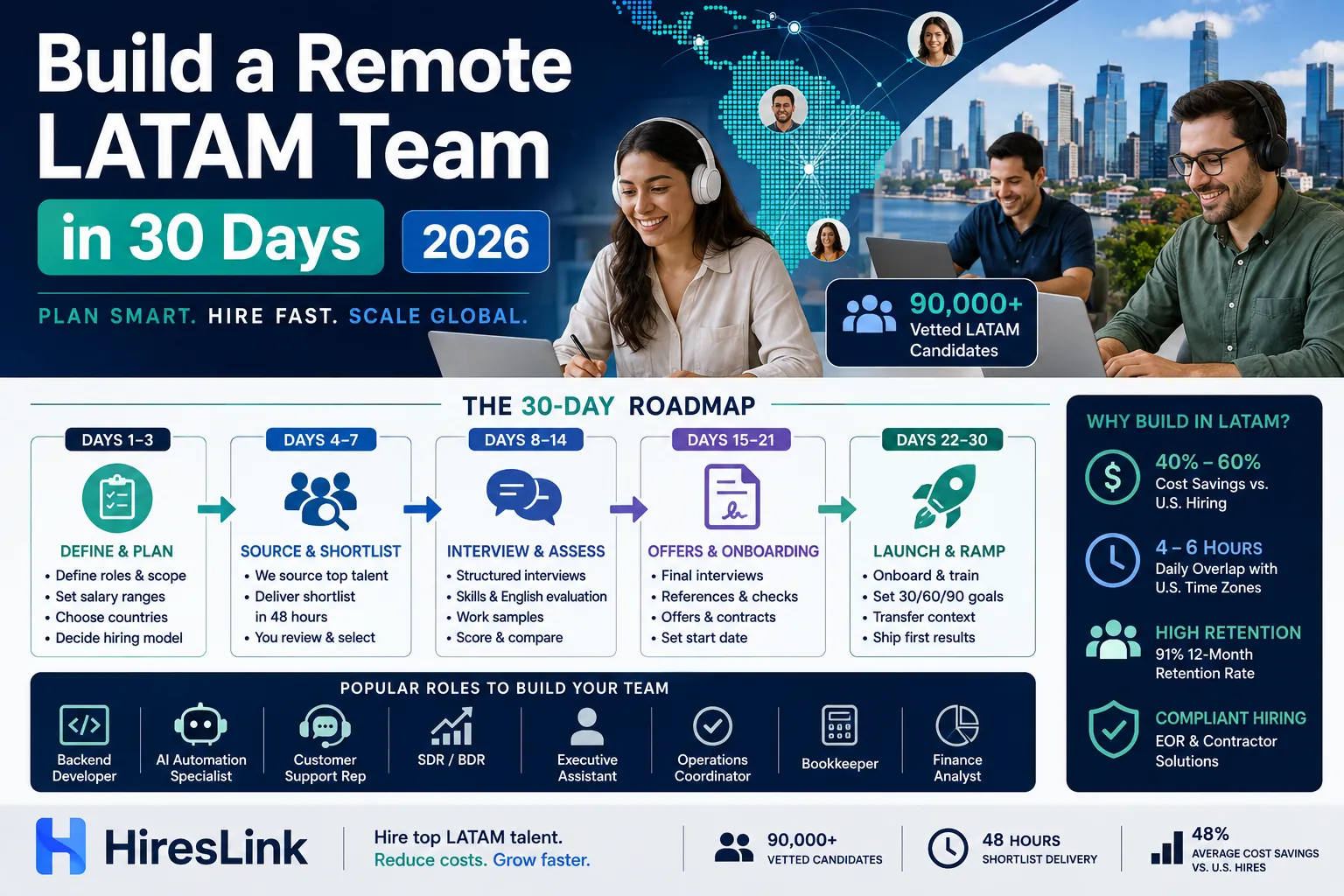
Quick Answer: To build a remote LATAM team in 30 days, start with 2–4 clearly defined roles, choose countries based on timezone and role fit, set salary ranges before sourcing, run a structured 5-business-day shortlist process, interview with scorecards, complete paid work samples within week 2, finalize offers by days 14–21, and use a focused onboarding plan for the final 7–10 days. HiresLink helps U.S. companies hire from 90,000+ vetted LATAM candidates, deliver shortlists in 5 business days, and build remote teams with average 48% cost savings vs. equivalent U.S. hires.
TL;DR — 7 numbers for building a LATAM team in 30 days
| # | Metric | 2026 value |
|---|---|---|
| 1 | Best team size for a 30-day build | 2–4 roles |
| 2 | Typical HiresLink shortlist timeline | 5 business days |
| 3 | Typical hiring timeline | 18–21 days |
| 4 | Recommended onboarding window | 7–10 days |
| 5 | Typical U.S.-LATAM workday overlap | 4–6 hours |
| 6 | HiresLink vetted LATAM candidate network | 90,000+ |
| 7 | Average cost savings vs. U.S. hiring | 48% |
Building a remote LATAM team in 30 days is realistic, but only if the company does the planning before the interviews start.
The mistake most founders make is opening roles before they know what they actually need.
They post a vague job description, interview too many people, change the salary range mid-process, delay feedback, skip the work sample, and then wonder why the best candidates disappear.
A 30-day LATAM hiring plan needs speed and structure.
You need a role brief, salary band, country strategy, timezone expectation, interview scorecard, work sample, offer process, contract structure, onboarding checklist, and manager ownership before sourcing begins.
That is where managed nearshore staffing can help. Instead of treating LATAM as one large talent pool, the hiring process should match each role to the right country, seniority, salary, English level, and collaboration window.
What kind of LATAM team can you build in 30 days?
A 30-day timeline works best for a focused team, not a full department.
The best starting point is usually 2–4 roles tied to a clear business bottleneck.
| Business goal | Best 30-day LATAM team |
|---|---|
| Reduce founder workload | Executive assistant + operations coordinator |
| Improve customer response | Customer support rep + operations coordinator |
| Build outbound capacity | SDR + sales support specialist |
| Increase product velocity | Backend developer + QA automation engineer |
| Ship AI workflows | AI automation specialist + AI integration engineer |
| Improve finance operations | Bookkeeper + finance assistant |
| Support a growing SaaS team | Backend developer + customer support rep + operations coordinator |
| Build an AI implementation pod | AI implementation specialist + AI integration engineer + workflow QA specialist |
A founder who wants to “hire a LATAM team” should first decide what problem the team solves.
If the real bottleneck is product delivery, start with technical roles. If the founder is drowning in inboxes, reporting, scheduling, and customer follow-ups, start with operations. If sales pipeline is the issue, start with SDR and RevOps support. If AI projects are stuck in pilot mode, start with an AI automation specialist or AI integration engineer.
The best 30-day teams are small, specific, and measurable.
30-day LATAM team-building roadmap
Here is the high-level timeline.
| Phase | Days | Goal |
|---|---|---|
| Phase 1 | Days 1–3 | Define roles, salary ranges, country strategy, hiring model |
| Phase 2 | Days 4–7 | Source candidates and deliver shortlists |
| Phase 3 | Days 8–14 | Run interviews, scorecards, and work samples |
| Phase 4 | Days 15–21 | Final interviews, references, offers, contracts |
| Phase 5 | Days 22–30 | Onboard, set goals, transfer context, launch first workflows |
The main rule: do not let interviews begin until the role is clear.
That may sound obvious, but it is the main reason 30-day hiring plans fail.
Days 1–3: define the team before sourcing
The first 3 days decide whether the process will move fast or become messy.
You need to define:
- roles
- seniority
- salary bands
- required English level
- timezone overlap
- country preferences
- hiring model
- interview process
- decision owner
- onboarding owner
- success metrics
A 30-day hiring plan needs one person on the client side who can make decisions quickly. If every interview needs 5 internal stakeholders, the timeline will break.
Build the role brief
Use this simple structure.
LATAM Role Brief

Company:
Role:
Department:
Manager:
Start date:
Hiring model:
Full-time / part-time / project:
Target countries:
Required timezone overlap:
Target monthly salary:
Stretch salary:
English level:
Top 5 responsibilities:
Top 5 must-have skills:
Nice-to-have skills:
Tools:
Success metrics after 30 days:
Success metrics after 90 days:
Interview process:
Work sample:
Offer deadline:
This role brief is especially important if you are hiring through staff augmentation, because the candidate needs to be productive inside your existing workflow quickly.
Choose the first roles carefully
For a 30-day build, avoid hiring roles that are too vague.
Good first roles:
| Role | Why it works |
|---|---|
| Backend Developer | Clear tickets, sprint work, code reviews, measurable output |
| Customer Support Representative | Clear coverage, tickets, response times, QA |
| SDR / BDR | Clear activity metrics, CRM workflows, meeting targets |
| Executive Assistant | Clear inbox, calendar, follow-up, admin workflows |
| Operations Coordinator | Clear recurring processes, reporting, handoffs |
| Bookkeeper | Clear financial workflows and monthly close support |
| AI Automation Specialist | Clear workflow builds and measurable time savings |
| AI Integration Engineer | Clear API, data, and tool integration projects |
Riskier first roles:
| Role | Why it can fail |
|---|---|
| “Generalist” | Too vague; everyone expects something different |
| “AI person” | Too broad unless workflows are defined |
| “Operations lead” | Can work, but needs clear authority |
| “Growth hacker” | Too many unclear expectations |
| “Founder’s right hand” | Often means 4 roles in one |
| “Developer who also does DevOps, AI, product, and support” | Usually unrealistic |
A strong role brief is better than a long job description.
Days 1–3: choose countries by role, not stereotype
LATAM is not one market.
Argentina, Colombia, Mexico, Brazil, Chile, Peru, Costa Rica, Panama, Ecuador, and Uruguay all have different strengths.
| Role | Best first-search countries |
|---|---|
| Backend developer | Argentina, Brazil, Colombia, Mexico, Chile, Uruguay |
| AI automation specialist | Argentina, Brazil, Colombia, Mexico, Chile |
| AI integration engineer | Argentina, Brazil, Mexico, Colombia, Chile |
| Customer support rep | Colombia, Mexico, Costa Rica, Panama, Peru, Ecuador |
| SDR / BDR | Mexico, Colombia, Costa Rica, Panama, Argentina |
| Executive assistant | Colombia, Mexico, Argentina, Costa Rica, Panama |
| Operations coordinator | Colombia, Mexico, Costa Rica, Peru, Panama |
| Bookkeeper | Argentina, Uruguay, Colombia, Mexico, Peru |
| Finance analyst | Argentina, Chile, Uruguay, Colombia, Mexico |
| Data analyst | Argentina, Brazil, Chile, Colombia, Mexico, Uruguay |
For example, a New York SaaS company hiring a backend developer may search Argentina, Brazil, Colombia, Mexico, Chile, and Uruguay. A Los Angeles company hiring a support rep may start with Mexico and Costa Rica because the timezone works better.
For a deeper market view, use HiresLink’s guide to the best countries in LATAM to hire remote talent before locking the search.
Days 1–3: set salary bands before interviews
Salary delays kill fast hiring.
Before sourcing starts, define:
- target monthly range
- stretch range
- whether range is fully loaded
- whether EOR or contractor costs are included
- whether bonuses or commissions apply
- whether equipment is included
- whether paid leave is included
- whether the role is full-time, part-time, or project-based
Use realistic bands. The cheapest candidate is not usually the best 30-day hire.
| Role | Mid-level LATAM monthly fully loaded |
|---|---|
| Backend Engineer | $3,800–$5,500 |
| AI Automation Specialist | $4,000–$5,200 |
| AI Integration Engineer | $5,200–$6,500 |
| Customer Support Representative | $1,600–$2,200 |
| SDR / BDR | $1,800–$2,600 |
| Executive Assistant | $1,900–$2,600 |
| Operations Coordinator | $2,000–$2,800 |
| Bookkeeper | $1,800–$2,600 |
| Finance Analyst | $3,200–$4,800 |
| Data Analyst | $3,200–$4,600 |
Figures are monthly fully loaded ranges. They include salary plus typical EOR or compliance-related cost assumptions. No hidden fees.
For a broader compensation view, use the LATAM salary guide by role and seniority and the LATAM salary benchmark hub before approving the search.
Days 1–3: decide the hiring model
The hiring model affects speed, cost, compliance, and onboarding.
| Hiring model | Best for | Speed | Watch-out |
|---|---|---|---|
| Contractor | Project-based, flexible, async work | Fast | Classification risk if managed like employee |
| EOR employee | Full-time embedded roles | Moderate | More setup, but cleaner employment structure |
| Staff augmentation | Embedded team members with managed support | Fast | Needs clear scope and manager ownership |
| Direct employee | Companies with local entity | Slower | More admin and local compliance |
| Project sprint | AI, automation, data, RevOps, workflow builds | Fast | Needs clear deliverables |
| Fractional specialist | Part-time expert support | Fast | Availability and handoff discipline matter |
A contractor can work well for a defined project. An EOR employee may be better for a full-time role with fixed hours and close management. Staff augmentation can work well when the company needs someone embedded quickly but still wants structured hiring support.
This article is for informational purposes only and is not legal advice.
Days 4–7: source and shortlist
Once the role brief is ready, sourcing can move fast.
For a 30-day plan, the shortlist should not include 25 candidates. It should include the strongest 3–5 candidates per role.
A good shortlist includes:
- resume
- location
- timezone
- salary expectation
- English level
- role fit summary
- tool fit summary
- risk notes
- availability
- interview recommendation
HiresLink typically delivers shortlists in 5 business days after the intake call, which is why the first week should focus on clarity and speed.
For companies hiring across several functions, HiresLink can use managed nearshore staffing to build role-by-role shortlists instead of forcing every role into one country or salary band.
What to look for in a shortlist
A good LATAM shortlist should not only say “this person is from Colombia” or “this developer knows Python.”
It should answer practical hiring questions.
| Question | Why it matters |
|---|---|
| Can they work the required U.S. overlap? | Prevents schedule problems |
| Is their English level enough for the role? | Prevents communication issues |
| Have they worked with U.S. teams before? | Reduces onboarding friction |
| Do they match the tool stack? | Shortens ramp time |
| Are they senior enough for the scope? | Prevents overmanagement |
| Is the salary realistic? | Prevents offer rejection |
| Are they available in the next 2–4 weeks? | Keeps 30-day timeline possible |
| Do they understand remote work? | Improves retention and execution |
The goal is not to interview everyone. The goal is to interview the right people quickly.
Days 8–14: run structured interviews
A fast process needs structured interviews.
Do not run casual “culture chats” first and technical testing later. That adds delays and creates inconsistent decisions.
Use this sequence:
| Step | Purpose | Length |
|---|---|---|
| Interview 1 | Role fit, English, remote habits, salary, availability | 30 minutes |
| Work sample | Test real job skills | 1–3 hours |
| Interview 2 | Deep-dive with hiring manager | 45–60 minutes |
| Final decision | Compare candidates using scorecard | Same day |
The hiring manager should give feedback within 24 hours after each interview.
If feedback takes 3–5 days, a 30-day hiring process becomes unrealistic.
Interview scorecard
Use the same scorecard for every candidate.
LATAM Interview Scorecard

Candidate:
Role:
Country:
Timezone:
Salary expectation:
Availability:

1. Role skills
Score 1–5:
Notes:

2. Tool fit
Score 1–5:
Notes:

3. English and communication
Score 1–5:
Notes:

4. Remote work habits
Score 1–5:
Notes:

5. Timezone fit
Score 1–5:
Notes:

6. Ownership level
Score 1–5:
Notes:

7. Work sample quality
Score 1–5:
Notes:

8. Culture and manager fit
Score 1–5:
Notes:

Decision:
[ ] Strong yes
[ ] Yes
[ ] Maybe
[ ] No

Next step:
This keeps decisions objective.
It also makes it easier to compare candidates from different countries. A Mexico-based SDR and Colombia-based SDR may both be strong, but one may fit better based on manager timezone and customer coverage.
Work samples by role
A work sample should test the job, not create free work for the company.
Keep it short, paid when appropriate, and realistic.
| Role | Work sample |
|---|---|
| Backend Developer | Review a small API task, debugging exercise, or architecture question |
| AI Automation Specialist | Map and build a small workflow in n8n, Make, Zapier, or similar |
| AI Integration Engineer | Explain API integration plan and handle a small technical exercise |
| Customer Support Rep | Respond to 3 sample tickets with escalation notes |
| SDR / BDR | Write 2 outbound emails and explain prospect research |
| Executive Assistant | Prioritize inbox/calendar scenarios |
| Operations Coordinator | Build a process checklist from messy instructions |
| Bookkeeper | Categorize transactions or review a sample reconciliation |
| Data Analyst | Clean a small dataset and explain findings |
| RevOps Specialist | Audit sample CRM records and recommend fixes |
A company hiring AI talent should be especially careful here. If the work is workflow-heavy, test workflow thinking. If the work is API-heavy, test technical integration. If the work is business-facing, test documentation and stakeholder communication.
For AI workflow builds, HiresLink’s Automation as a Service can also be used as a lower-risk starting point before building a larger permanent team.
Days 15–21: references, offers, and contracts
By week 3, the company should be ready to make offers.
This is where many hiring processes slow down for no reason.
Before the final interview, prepare:
- approved salary range
- offer template
- hiring model
- contract path
- start date options
- equipment plan
- software access plan
- onboarding owner
- first 30-day goals
- backup candidate choice
If the candidate is strong, do not wait a week to decide.
Good LATAM candidates with U.S. experience, strong English, and strong remote habits usually have other options.
Offer checklist
LATAM Offer Checklist

Candidate:
Role:
Country:
City:
Timezone:
Start date:
Hiring model:
Monthly cost:
Payment currency:
Working hours:
Required U.S. overlap:
Local holidays:
PTO / time-off policy:
Equipment:
Tools:
Manager:
Onboarding owner:
First 30-day goals:
First 90-day goals:
Contract sent:
Contract signed:
A clear offer reduces confusion and improves acceptance.
Days 22–30: onboard the team
Hiring is not finished when the contract is signed.
The final week of the 30-day plan should focus on onboarding.
A remote LATAM hire needs:
- company context
- role goals
- tool access
- manager cadence
- communication norms
- documentation
- first tasks
- success metrics
- escalation process
- local holiday clarity
- timezone expectations
If the company skips onboarding, the hire may technically start on time but still take too long to become productive.
Use HiresLink’s remote employee onboarding checklist to structure the first week properly.
7-day onboarding plan for LATAM hires
| Day | Focus | Output |
|---|---|---|
| Day 1 | Welcome, tools, company context | Access confirmed, intro calls completed |
| Day 2 | Role walkthrough and success metrics | 30/60/90-day goals documented |
| Day 3 | Workflow shadowing | First workflow map created |
| Day 4 | First small task | Task completed and reviewed |
| Day 5 | Feedback and documentation | Gaps documented, questions answered |
| Day 6 | Independent work block | Candidate owns first recurring task |
| Day 7 | Manager review | Next 2-week plan confirmed |
A strong first week makes the rest of the month easier.
The manager should not disappear after the welcome call. Remote hires need faster context transfer, especially if they are joining a small U.S. team with undocumented processes.
First 30-day goals by role
Set goals before the hire starts.
| Role | First 30-day goal |
|---|---|
| Backend Developer | Ship 1–3 meaningful tickets, complete codebase onboarding, join sprint rhythm |
| AI Automation Specialist | Map 2 workflows, ship 1 pilot automation, document failure points |
| Customer Support Rep | Handle low-risk tickets independently, learn escalation rules |
| SDR / BDR | Build lead list, run first outbound sequences, update CRM cleanly |
| Executive Assistant | Own calendar, inbox triage, follow-ups, recurring admin workflows |
| Operations Coordinator | Document recurring workflows and own 1–2 weekly processes |
| Bookkeeper | Learn chart of accounts, support first reporting cycle |
| Finance Analyst | Produce first clean report or dashboard |
| RevOps Specialist | Audit CRM, fix priority fields, document process gaps |
| Data Analyst | Clean first dataset and deliver first insight report |
The goal is not perfection. The goal is measurable traction.
Best LATAM team structures for U.S. companies
A good remote team is designed around business outcomes.
Team structure 1: Founder support pod
| Role | Purpose |
|---|---|
| Executive Assistant | Calendar, inbox, scheduling, follow-ups |
| Operations Coordinator | Process ownership, reporting, customer handoffs |
| Bookkeeper | Invoices, categorization, monthly finance support |
Best for founders who are doing too much admin and operations themselves.
Team structure 2: SaaS execution pod
| Role | Purpose |
|---|---|
| Backend Developer | Product velocity |
| Customer Support Representative | Customer response and ticket coverage |
| Operations Coordinator | Internal handoffs and reporting |
Best for SaaS companies that need product and customer operations capacity without hiring only in the U.S.
Team structure 3: AI implementation pod
| Role | Purpose |
|---|---|
| AI Automation Specialist | Workflow design and no-code/low-code implementation |
| AI Integration Engineer | APIs, data, authentication, LLM integrations |
| Workflow QA / AI Ops Specialist | Monitoring, QA, documentation, fixes |
Best for companies that have AI pilots but need production-ready workflows.
Team structure 4: Sales development pod
| Role | Purpose |
|---|---|
| SDR / BDR | Prospecting, outreach, meeting booking |
| Sales Support Specialist | Lead research, CRM hygiene, follow-up coordination |
| RevOps Specialist | Reporting, sequences, automation, pipeline hygiene |
Best for companies building outbound capacity with better timezone overlap than offshore teams.
Team structure 5: Finance and operations pod
| Role | Purpose |
|---|---|
| Bookkeeper | Monthly financial workflows |
| Finance Assistant | Invoices, approvals, reporting support |
| Operations Coordinator | Cross-functional follow-ups and documentation |
Best for services companies, agencies, healthcare businesses, and growing SMBs.
Timezone planning for a 30-day LATAM team
Timezone should be written into every role brief.
| U.S. timezone | Best LATAM starting countries |
|---|---|
| EST / ET | Colombia, Panama, Peru, Ecuador, Argentina, Uruguay, Brazil, Chile |
| CST / CT | Mexico, Costa Rica, Colombia, Panama, Peru, Guatemala |
| MST / MT | Mexico, Costa Rica, Guatemala, El Salvador, Honduras, Nicaragua, Colombia |
| PST / PT | Mexico, Costa Rica, Guatemala, El Salvador, Honduras, Nicaragua, Colombia |
For EST teams, most of LATAM can work well. For PST teams, Mexico and Central America usually make more sense for customer-facing roles.
For deeper planning, use the LATAM time zones guide and the EST vs CST vs PST hiring guide before finalizing the country list.
Cost plan for a 30-day LATAM team
Here are common team budgets.
$8K–$10K/month team
| Role | Monthly fully loaded range |
|---|---|
| Customer Support Rep | $1,600–$2,200 |
| Operations Coordinator | $2,000–$2,800 |
| Executive Assistant | $1,900–$2,600 |
| Bookkeeper | $1,800–$2,600 |
| Total | $7,300–$10,200/month |
Best for founder support, customer operations, and admin capacity.
$12K–$16K/month team
| Role | Monthly fully loaded range |
|---|---|
| Backend Engineer | $3,800–$5,500 |
| Customer Support Rep | $1,600–$2,200 |
| Operations Coordinator | $2,000–$2,800 |
| AI Automation Specialist | $4,000–$5,200 |
| Total | $11,400–$15,700/month |
Best for SaaS teams adding product, support, operations, and automation capacity.
$20K–$28K/month team
| Role | Monthly fully loaded range |
|---|---|
| Senior Backend Engineer | $5,500–$7,000 |
| AI Integration Engineer | $5,200–$6,500 |
| RevOps Specialist | $3,500–$5,600 |
| Customer Support Rep | $1,600–$2,200 |
| Operations Coordinator | $2,000–$2,800 |
| Executive Assistant | $1,900–$2,600 |
| Total | $19,700–$26,700/month |
Best for growing teams that need engineering, AI, sales systems, support, and operations capacity.
U.S. vs LATAM team cost comparison
| Team | LATAM annual fully loaded | U.S. annual fully loaded | Typical annual savings |
|---|---|---|---|
| Founder support pod | $66K–$94K | $180K–$267K | $86K–$201K |
| SaaS execution pod | $137K–$188K | $370K–$568K | $182K–$431K |
| AI implementation pod | $158K–$202K | $390K–$685K | $188K–$527K |
| Sales development pod | $87K–$146K | $220K–$370K | $74K–$283K |
| Finance and operations pod | $67K–$101K | $180K–$277K | $79K–$210K |
Figures are fully loaded estimates. Actual cost depends on role, seniority, country, English level, hiring model, benefits, and scope.
The best way to compare cost is fully loaded U.S. cost vs fully loaded LATAM cost. U.S. employer cost includes more than salary, which is why the nearshore hiring cost comparison is useful before deciding team size.
Get the 2026 LATAM Talent Report
90K+ vetted candidates · salary data by role, seniority, country, and hiring model.
Communication system for the first 30 days
A remote team needs communication rules.
Do not leave this to chance.
Define:
- daily update format
- weekly manager check-in
- response-time expectations
- Slack or Teams channel structure
- escalation process
- documentation location
- meeting cadence
- project management tool
- handoff rules
- local holiday calendar
A simple daily update can look like this:
Daily Update

Yesterday:
- Completed:
- Blocked by:
- Waiting on:

Today:
- Priority 1:
- Priority 2:
- Priority 3:

Questions:
-

Risks:
-
This format works for most remote roles because it forces visibility without creating extra meetings.
Remote work policy basics
Before the team starts, define the basics:
| Policy area | What to include |
|---|---|
| Working hours | Local schedule and U.S. overlap |
| Time off | Local holidays, PTO, sick days |
| Communication | Slack, email, meetings, response times |
| Security | Password manager, device policy, 2FA |
| Tools | Project management, CRM, support desk, code repo |
| Performance | First 30/60/90-day goals |
| Escalation | What counts as urgent and who owns it |
| Documentation | Where SOPs and handoffs live |
| Confidentiality | Customer data and internal information |
| Equipment | Laptop, monitors, software, reimbursement |
This does not need to be a 40-page handbook. It needs to be clear enough that the hire knows how to work.
You can use HiresLink’s remote work policy template as the starting point.
30/60/90-day plan for a remote LATAM team
A 30-day hire plan should lead into a 90-day success plan.
| Period | Goal | What to measure |
|---|---|---|
| Days 1–30 | Ramp and first ownership | Tools, workflows, first tasks, communication |
| Days 31–60 | Independent execution | Output quality, speed, reliability, fewer manager corrections |
| Days 61–90 | Process improvement | Ownership, documentation, measurable business impact |
Sample 30/60/90 plan
30 days:
- Complete onboarding
- Learn tools and workflows
- Own first recurring task
- Document questions and gaps
- Join manager cadence

60 days:
- Own recurring workflow independently
- Reduce manager follow-ups
- Improve one existing process
- Hit role-specific KPIs

90 days:
- Own the function or workflow with minimal supervision
- Document SOPs
- Identify bottlenecks
- Recommend improvements
- Become a reliable part of the team
This structure is especially important when building a team quickly. Fast hiring only works if the first 90 days are managed properly.
Compliance and EOR setup
Hiring in LATAM is normal for U.S. companies, but structure matters.
The company should decide whether each hire is:
- contractor
- EOR employee
- direct employee
- part-time specialist
- project-based consultant
- staff augmentation hire
The setup should cover:
| Area | What to confirm |
|---|---|
| Worker classification | Contractor, EOR employee, direct employee, or consultant |
| IP assignment | Code, designs, prompts, workflows, documents, SOPs, and work product |
| Confidentiality | NDA, customer data, internal systems, trade secrets |
| Payroll / invoices | USD invoicing, payment timing, tax documentation |
| Local holidays | Which holidays are observed |
| Working hours | Local schedule and U.S. overlap window |
| Benefits / paid leave | Based on country and hiring model |
| Equipment | Laptop, software, security tools |
| Security | Password manager, 2FA, API keys, access control |
| Replacement support | Notice period, handoff, documentation, backup plan |
HiresLink supports compliant LATAM hiring through structured contracts and EOR-backed workflows, including hiring support through Bait INC, a Delaware C-Corp, where applicable. That helps U.S. companies manage LATAM hiring with cleaner documentation, USD invoicing, IP protection, onboarding, and support.
This article is for informational purposes only and is not legal advice.
Common mistakes when building a LATAM team in 30 days
Mistake 1: Hiring before defining the work
A vague role creates vague interviews, vague salary bands, and vague performance expectations.
Mistake 2: Choosing one country for every role
A backend developer, SDR, customer support rep, and operations coordinator may each fit a different LATAM country best.
Mistake 3: Comparing salary only
Compare fully loaded cost, timezone overlap, English level, seniority, and manager time.
Mistake 4: Moving too slowly after interviews
Good candidates will not wait two weeks for feedback.
Mistake 5: Skipping the work sample
A resume is not enough. Test the actual work.
Mistake 6: Overloading the first week
Do not throw every system and process at the hire on day 1. Sequence the onboarding.
Mistake 7: Treating LATAM as cheap labor
The best LATAM hires are strategic team members, not discount replacements.
Mistake 8: Not documenting communication norms
Remote teams fail when people do not know when to update, where to ask, or how to escalate.
Mistake 9: Forgetting local holidays
Holiday planning affects onboarding, support, payroll, customer handoffs, and launch timelines.
Mistake 10: Hiring too junior for ownership
If you need someone to “take this off my plate,” budget for mid-level or senior talent.
Case study — U.S. SaaS company building a LATAM team in 30 days
A U.S. SaaS company with 51 employees needed to build a small LATAM team quickly without increasing U.S. payroll burn.
The company needed:
- a backend developer
- a customer support representative
- an operations coordinator
- an AI automation specialist
The founder originally wanted to open all roles at once with broad job descriptions. HiresLink helped narrow the scope, set salary bands, choose country priorities, and build a structured 30-day hiring plan.
The search plan:
| Role | Country focus | Why |
|---|---|---|
| Backend Developer | Argentina, Brazil, Colombia, Mexico | Technical depth and overlap |
| Customer Support Representative | Colombia, Panama, Peru, Costa Rica | EST coverage and customer communication |
| Operations Coordinator | Colombia, Mexico, Peru, Costa Rica | Daily handoffs and process ownership |
| AI Automation Specialist | Argentina, Mexico, Colombia, Brazil | Workflow automation and U.S. stakeholder overlap |
What happened:
- Day 1: Intake call completed
- Day 2: Role briefs and salary bands approved
- Day 4: First shortlist delivered
- Day 7: All shortlists delivered
- Days 8–13: Interviews and work samples completed
- Days 15–19: Final interviews and references completed
- Days 20–23: Offers signed
- Days 24–30: Onboarding, tool access, and first tasks completed
- Average daily overlap: 4–6 hours
- 12-month retention: 4 of 4 hires retained
The numbers:
| Metric | Result |
|---|---|
| Annual LATAM fully loaded cost | $147K–$202K |
| Equivalent U.S. fully loaded cost | $420K–$670K |
| Annual savings | $218K–$523K |
| Time to first shortlist | 5 business days |
| Time to full team | 23 days |
| Time to first productive workflow | 30 days |
“We thought speed meant rushing. The difference was structure. Once the roles, countries, and salary bands were clear, the hiring moved fast.”
— COO, U.S. SaaS company
Vendor comparison — building a LATAM team quickly
| Vendor | Pool | 30-day team-building support | EOR included | Best for |
|---|---|---|---|---|
| HiresLink | 90K+ vetted LATAM candidates | Role briefs, salary benchmarks, country strategy, shortlist, interview support, onboarding, and EOR-backed workflows | Supported through structured EOR workflows | U.S. companies building small LATAM teams quickly with strategy and compliance |
| HireWithNear | Broad LATAM talent pool | General remote hiring support | Varies | Companies hiring business roles across LATAM |
| Revelo | LATAM tech marketplace | Stronger focus on developers | Platform-dependent | Companies hiring full-time LATAM engineers |
| BairesDev | Large LATAM engineering network | Enterprise engineering delivery | Varies | Larger engineering-heavy projects |
| Toptal | Global freelance network | Senior freelance matching | Limited / varies | High-budget specialist freelancers |
| Upwork | Massive open marketplace | Self-managed hiring | No | Small freelance tasks and manual screening |
| Deel | Global EOR and contractor platform | Employment infrastructure, not sourcing-first | Yes | Companies that already found candidates |
| Remote | Global employment infrastructure | Employment and payroll setup | Yes | Global payroll and EOR support |
HiresLink is usually the strongest fit when a company needs both the talent search and the operating plan: roles, countries, salary ranges, shortlists, contracts, onboarding, and retention support.
A marketplace can work if the company has time to screen. An EOR platform can work if the company already found the candidates. A managed hiring partner is stronger when the company needs to build a team quickly without losing structure.
FAQ
Can you really build a remote LATAM team in 30 days?
Yes, if the team is focused and the company is ready to make decisions quickly. A 30-day timeline works best for 2–4 roles with clear job briefs, salary bands, timezone expectations, interview scorecards, work samples, and onboarding plans.
What roles should I hire first in LATAM?
The best first roles are usually backend developer, customer support representative, SDR, executive assistant, operations coordinator, bookkeeper, AI automation specialist, and AI integration engineer. The right choice depends on the company bottleneck.
How fast can HiresLink deliver LATAM candidates?
HiresLink typically delivers a shortlist within 5 business days after the intake call. The full hiring timeline usually depends on role clarity, salary range, interview speed, candidate availability, and contract setup.
What is the best country to build a LATAM team?
There is no single best country. Argentina is strong for technical, AI, finance, and senior roles. Colombia is strong for EST support, sales, and operations. Mexico is strong for CST, MST, and PST teams. Brazil, Chile, Uruguay, Peru, Costa Rica, Panama, and Ecuador can also be strong depending on the role.
How much does it cost to build a LATAM team?
A small LATAM team can cost anywhere from $7K–$27K/month depending on team size, seniority, roles, country mix, and hiring model. A founder support pod may cost under $10K/month, while a larger SaaS or AI pod may cost $15K–$27K/month.
Should I hire contractors or EOR employees?
It depends on the role, country, working hours, exclusivity, management style, and compliance risk. Contractors can work for project-based or flexible work. EOR employees are often better for full-time embedded roles with fixed schedules and close management.
What causes 30-day hiring plans to fail?
The most common causes are vague roles, slow feedback, unclear salary bands, too many decision-makers, no work sample, poor onboarding, weak timezone planning, and unclear compliance structure.
How many hours of overlap do LATAM teams need?
Most U.S.-LATAM teams need 4–6 hours of daily overlap. Customer support and customer success may need more. Developers, AI specialists, finance analysts, and other async-friendly roles may need less if documentation and manager cadence are strong.
Should I hire all roles from one country?
Not always. A 3-person team may work better with one hire in Argentina, one in Colombia, and one in Mexico. Role-country fit matters more than forcing one country for simplicity.
What should happen in the first week after hiring?
The first week should include tool access, company context, role goals, workflow shadowing, first small task, manager feedback, documentation, and a clear two-week execution plan.
Final takeaways
A remote LATAM team can be built in 30 days when the process is structured.
The safest path is:
- Define 2–4 roles clearly.
- Set salary bands before sourcing.
- Choose countries by role and timezone.
- Decide contractor, EOR, staff augmentation, or project setup.
- Review shortlists quickly.
- Use scorecards and work samples.
- Make offers by days 15–21.
- Use days 22–30 for onboarding and first productive work.
The goal is not just to hire fast. The goal is to build a team that can produce real output within the first month.
HiresLink helps U.S. companies build LATAM teams with structured shortlists, salary benchmarks, EOR-backed workflows, contracts, onboarding, and practical country guidance.
Get the 2026 LATAM Talent Report
Real numbers by role, seniority, and country — built from HiresLink’s 90,000+ candidate network.
Ready to build your remote LATAM team?
Start Hiring → · Talk to an Expert →
Related HiresLink articles
- LATAM Salary Guide by Role and Seniority [2026]
- Nearshore Hiring Cost Comparison: US vs LATAM [2026]
- Best Countries in LATAM to Hire Remote Talent in 2026
- Argentina vs Colombia vs Mexico for Remote Hiring [2026]
- LATAM Time Zones Guide for US Employers [2026]
- EST vs CST vs PST: Best LATAM Countries to Hire From [2026]
- Remote Employee Onboarding Checklist 2026
- Remote Work Policy Template 2026
- How to Hire an AI Implementation Specialist [2026]
- How to Hire AI Engineers From LATAM [2026]
- HiresLink Resources
- See All Nearshore Talent
Sources
- BLS — Employer Costs for Employee Compensation
- BLS — Average hourly employer costs for employee compensation
- BLS — Software Developers, Quality Assurance Analysts, and Testers
- BLS — Customer Service Representatives
- BLS — Secretaries and Administrative Assistants
- BLS — Bookkeeping, Accounting, and Auditing Clerks
- IANA Time Zone Database
- Timeanddate — Daylight Saving Time Around the World 2026
- HiresLink Talent Pool Intelligence Report 2026, proprietary, n=90,000+ vetted candidates.
- HiresLink internal hiring benchmarks: 5-business-day shortlist, 18–21 day average time-to-hire, 91–92% 12-month retention, and 48% average cost savings.
- U.S. compensation ranges reflect 2025–2026 market salary benchmarks and fully loaded employer cost assumptions.
This article is for informational purposes only and is not legal advice.
About HiresLink Team
Expert insights from the HiresLink team on hiring LATAM tech talent, remote work, and building distributed teams.
Table of Contents
Related Articles


Ready to Hire Top LATAM Talent?
Get matched with pre-vetted developers, designers, and specialists in 5 business days.