Best Countries in LATAM to Hire Remote Talent in 2026
Compare the best LATAM countries to hire remote talent in 2026 by role, timezone, salary, English level, talent depth, and hiring model."
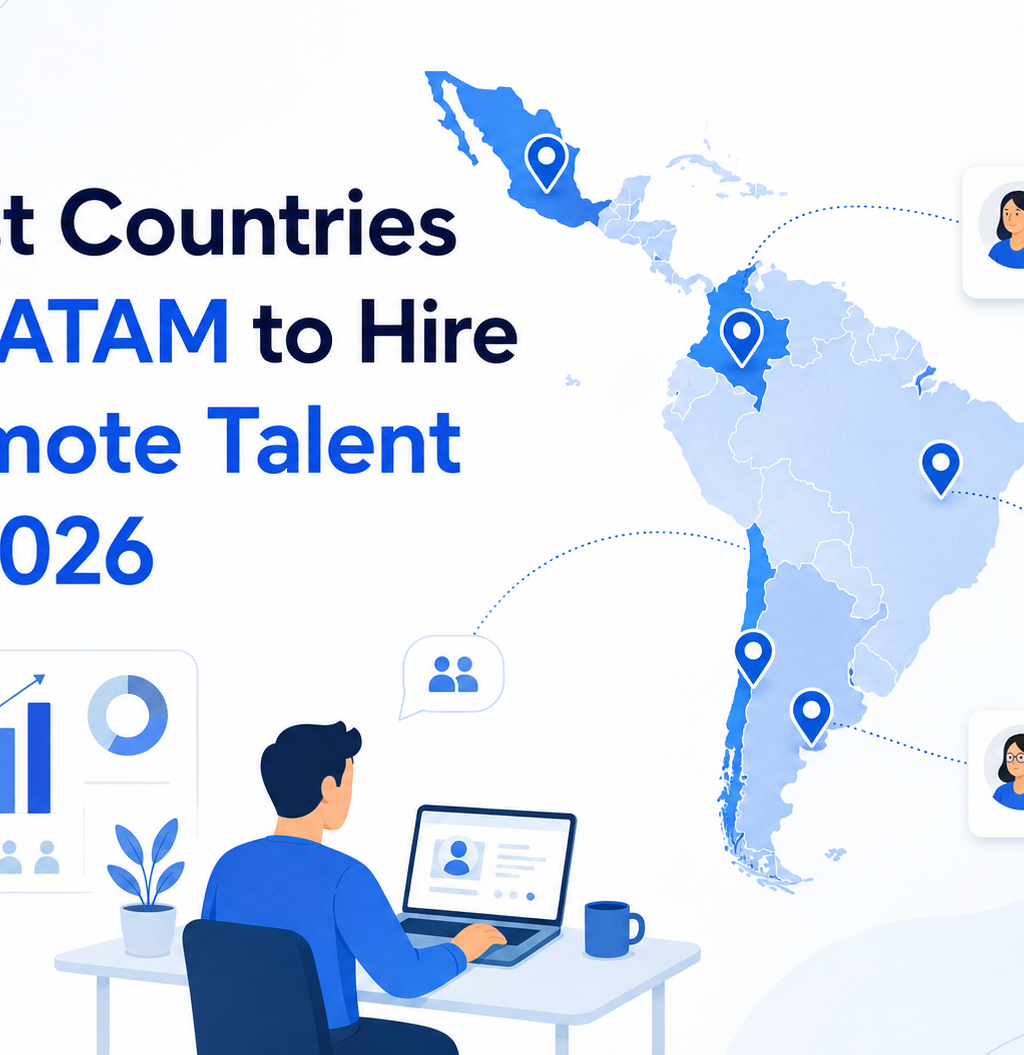
Quick Answer: The best countries in LATAM to hire remote talent in 2026 depend on the role. Argentina is strongest for senior technical, AI, finance, and operations talent. Colombia is one of the best markets for customer support, sales, operations, and EST overlap. Mexico is usually the best fit for CST, MST, and PST teams. Brazil has the largest technical market, especially for engineering, data, product, and AI-adjacent roles. Chile and Uruguay are strong for senior, professional, and finance-heavy roles. Costa Rica, Peru, Panama, and Ecuador can work well for support, operations, admin, finance, and bilingual coordination. HiresLink helps U.S. companies hire from 90,000+ vetted LATAM candidates, deliver shortlists in 48 hours, and build remote teams with average 48% cost savings vs. equivalent U.S. hires.
TL;DR — 7 numbers for hiring remote talent in LATAM
| # | Metric | 2026 value |
|---|---|---|
| 1 | HiresLink vetted LATAM candidate network | 90,000+ |
| 2 | HiresLink AI-screened specialist pool | 15,000+ |
| 3 | Typical shortlist timeline | 48 hours |
| 4 | Typical hiring timeline | 18–21 days |
| 5 | Typical U.S.-LATAM workday overlap | 4–6 hours |
| 6 | HiresLink average cost savings vs. U.S. hiring | 48% |
| 7 | Best first-search countries for most U.S. teams | Argentina, Colombia, Mexico, Brazil, Chile |
LATAM is not one talent market.
That is the biggest mistake U.S. companies make when hiring in Latin America. They search for “LATAM talent” as if Argentina, Mexico, Colombia, Brazil, Chile, Uruguay, Peru, Costa Rica, Panama, and Ecuador all offer the same skills, salary bands, English levels, holidays, and timezone overlap.
They do not.
A startup hiring a senior backend engineer should not use the same country strategy as a law firm hiring a bilingual intake specialist. A San Francisco SaaS company hiring customer support should not use the same country map as a New York fintech hiring a finance analyst. A founder hiring an AI automation specialist needs a different shortlist than a company hiring a junior virtual assistant.
The best LATAM hiring strategy is role-specific.
Start with the work, then choose the country.
Best LATAM countries to hire from in 2026
Here is the practical country-by-country view for U.S. employers.
| Country | Best for | Timezone fit | Talent depth | Hiring note |
|---|---|---|---|---|
| Argentina | Engineering, AI, finance, ops, senior specialists | Strong for EST/CST | Very strong | Best all-around market for senior technical and operator talent |
| Colombia | Support, sales, operations, software, bilingual roles | Excellent for EST/CST | Strong | One of the easiest markets for U.S. collaboration |
| Mexico | Support, sales, engineering, admin, bilingual roles | Excellent for CST/MST/PST | Strong | Best first-search market for West Coast and Central U.S. teams |
| Brazil | Engineering, AI, product, design, data, enterprise systems | Strong for EST/CST, city-dependent | Very strong | Largest technical market, but Portuguese and city/timezone matter |
| Chile | Engineering, finance, operations, professional services | Strong for EST/CST | Strong | Good for senior professional and specialist roles |
| Uruguay | Engineering, finance, operations, senior independent roles | Strong for EST/CST | Smaller but strong | Good for experienced, independent hires |
| Peru | Support, operations, finance, sales, software | Strong for EST/CST | Mid-sized | Good value for operations and back-office roles |
| Costa Rica | Support, ops, finance, admin, bilingual customer roles | Excellent for CST/MST/PST | Smaller but useful | Strong U.S. timezone fit and professional services background |
| Panama | Support, operations, finance, logistics, bilingual roles | Excellent for EST/CST | Smaller but useful | Good for customer-facing coordination and logistics-adjacent roles |
| Ecuador | Support, operations, admin, finance, software | Strong for EST/CST | Emerging | Useful for timezone-aligned operational roles |
The best country is not always the biggest country. It is the country where the role, manager timezone, salary range, English requirement, and hiring speed all line up.
For a full market overview, use HiresLink’s Hiring in LATAM 2026 guide alongside the LATAM salary benchmark hub before choosing where to start.
Best overall country: Argentina
Argentina is usually one of the strongest LATAM countries for remote hiring, especially for technical, AI, finance, and senior operations roles.
It has a deep pool of software developers, product-minded operators, finance professionals, data talent, automation builders, and bilingual professionals who are used to working with U.S. and international companies.
| Argentina hiring factor | Employer view |
|---|---|
| Best roles | Backend developers, AI specialists, finance analysts, RevOps, operations managers, product roles |
| Timezone | Strong EST/CST overlap |
| English level | Strong among remote-ready candidates |
| Seniority | Strong mid, senior, and lead talent |
| Cost | Usually lower than U.S. hiring, but senior talent is not “cheap” |
| Watch-out | Economic volatility, holiday planning, and salary expectations for top talent |
Argentina is a good first-search country when the role needs judgment, technical maturity, independence, and real-time collaboration with U.S. teams.
It is especially strong for companies hiring nearshore developers, AI specialists, backend engineers, automation builders, finance analysts, and technical operators.
The main mistake is treating Argentina as a low-cost-only market. The strongest Argentine candidates often have international experience and multiple offers. They are still usually more affordable than equivalent U.S. hires, but they should be positioned as strategic hires, not discount labor.
Best for EST operations and customer-facing roles: Colombia
Colombia is one of the easiest LATAM countries for U.S. teams to work with because the timezone fit is excellent, especially for East Coast and Central U.S. companies.
It is also a strong market for customer support, sales development, operations, project coordination, customer success, finance support, recruiting, and software roles.
| Colombia hiring factor | Employer view |
|---|---|
| Best roles | Customer support, SDRs, operations, finance support, EAs, software developers |
| Timezone | Excellent EST/CST overlap |
| English level | Strong enough for many bilingual roles, but must be screened carefully |
| Seniority | Strong junior-to-mid and growing senior pool |
| Cost | Strong value for operations and customer-facing roles |
| Watch-out | Many public holidays, especially Monday holidays |
Colombia is a good choice when the role depends on live collaboration. For example, a U.S. company hiring a customer support representative, SDR, operations coordinator, or executive assistant may get better daily rhythm from Colombia than from a technically stronger but less aligned country.
Colombia is also a good option for companies hiring technical roles that need frequent standups, support escalations, customer feedback loops, or product collaboration.
If the role requires consistent daily availability, review Colombia’s holiday calendar early and add local dates into onboarding. HiresLink’s Colombia public holidays guide can help managers avoid scheduling launches or onboarding during local long weekends.
Best for CST, MST, and PST teams: Mexico
Mexico is usually the best first-search country for U.S. companies in Central, Mountain, and Pacific timezones.
For Texas, California, Arizona, Colorado, Nevada, Washington, and other western U.S. teams, Mexico often gives the cleanest overlap. It also has a large and varied talent market across software, support, admin, customer operations, finance, sales, marketing, and bilingual coordination roles.
| Mexico hiring factor | Employer view |
|---|---|
| Best roles | SDRs, support, operations, admin, finance, engineering, bilingual roles |
| Timezone | Excellent for CST/MST/PST |
| English level | Strong candidates exist, but English screening matters |
| Seniority | Strong junior-to-senior pool depending on role |
| Cost | Strong value, especially for U.S.-facing operations |
| Watch-out | Multiple time zones and some region-specific DST rules |
Mexico is often the best country for companies that need direct overlap with a West Coast or Texas-based manager.
A San Francisco company hiring customer support may want Mexico before Argentina. A Dallas company hiring an SDR may start with Mexico before Colombia. A Los Angeles founder hiring an executive assistant may prefer Mexico or Costa Rica because the daily overlap is easier.
For technical roles, Mexico can also be strong, but the best approach is to search by role rather than country only. A great senior backend developer may still come from Argentina, Brazil, Colombia, or Chile depending on the stack.
If timezone is the main deciding factor, use the LATAM time zones guide before finalizing the search.
Best for technical scale: Brazil
Brazil has the largest talent market in LATAM. It is especially strong for software engineering, data, cloud, AI, product, design, DevOps, enterprise systems, and technical operations.
The main difference is that Brazil is Portuguese-speaking, while most other LATAM countries in this list are Spanish-speaking. That does not make Brazil a bad fit. It just means English screening and role fit matter more.
| Brazil hiring factor | Employer view |
|---|---|
| Best roles | Software developers, AI, data, cloud, DevOps, product, design, enterprise systems |
| Timezone | Strong for EST/CST, but city-dependent |
| English level | Strong candidates exist, but screen carefully |
| Seniority | Strong mid, senior, and specialist talent |
| Cost | Competitive for technical hiring compared with U.S. salaries |
| Watch-out | Portuguese market, multiple time zones, local holiday differences |
Brazil is a strong option when the company needs technical depth and is willing to screen carefully for English, communication style, and U.S. work experience.
It can be especially useful for companies hiring backend developers, data engineers, AI integration engineers, product engineers, DevOps engineers, and design/product specialists.
The main operational mistake is writing “Brazil time” in a job post. Brazil has multiple time zones, so U.S. companies should confirm the candidate’s city before setting work hours.
For holiday planning, use HiresLink’s Brazil public holidays guide, especially if the role involves support coverage, finance close, or production releases.
Best for senior professional roles: Chile
Chile is a strong LATAM market for professional, technical, finance, operations, and specialist roles.
It is not always the first country companies think of, but it can be a good fit when the role needs maturity, structure, technical competence, and strong business communication.
| Chile hiring factor | Employer view |
|---|---|
| Best roles | Engineering, finance, analytics, product, operations, professional services |
| Timezone | Strong for EST/CST, but DST matters |
| English level | Strong among remote-ready professional candidates |
| Seniority | Good senior and specialist pool |
| Cost | Good value, though not always the cheapest |
| Watch-out | DST changes and Fiestas Patrias holiday planning |
Chile can work well for SaaS, fintech, operations-heavy companies, analytics teams, finance teams, and technical projects.
It is not always the best market if the company needs a large number of junior low-cost hires fast. But it is useful when the role requires reliability, seniority, and professional judgment.
For companies hiring AI, automation, or technical implementation roles, Chile can be part of the shortlist alongside Argentina, Brazil, Colombia, and Mexico.
Best smaller market for senior independent hires: Uruguay
Uruguay is a smaller market, but it can be strong for experienced remote professionals.
The talent pool is not as large as Brazil, Mexico, Argentina, or Colombia. But for certain roles, Uruguay can produce high-quality candidates who are comfortable with remote work, international teams, and independent execution.
| Uruguay hiring factor | Employer view |
|---|---|
| Best roles | Engineering, finance, operations, senior analysts, technical specialists |
| Timezone | Strong EST/CST overlap |
| English level | Strong among remote-ready professionals |
| Seniority | Smaller but good senior pool |
| Cost | Good value, but not the lowest-cost market |
| Watch-out | Smaller candidate volume and holiday-policy differences |
Uruguay is usually not the first place to search if speed and volume matter most. But it can be a strong market for senior, independent, high-trust hires.
It works well for companies that want one strong person rather than a large hiring funnel.
Best value markets for operations: Peru and Ecuador
Peru and Ecuador can be useful markets for U.S. companies hiring operations, support, admin, finance coordination, sales support, and bilingual remote roles.
They may not always have the same technical depth as Argentina, Brazil, Mexico, or Colombia, but they can be strong for practical, timezone-aligned business roles.
| Country | Best for | Employer note |
|---|---|---|
| Peru | Operations, support, finance, sales, admin, software | Strong EST/CST overlap and good value |
| Ecuador | Support, operations, admin, finance, software | Good timezone fit and emerging remote talent pool |
Peru can work well for companies hiring finance assistants, customer support reps, operations coordinators, virtual assistants, and junior-to-mid software roles.
Ecuador can be a useful option for companies that want U.S.-friendly hours, steady operations support, and bilingual coordination.
For these markets, screening matters. U.S. companies should test written English, work samples, tool fluency, response speed, and manager communication before making an offer.
Best for bilingual support and coordination: Costa Rica and Panama
Costa Rica and Panama are smaller markets, but they can be strong for U.S.-aligned support, operations, admin, logistics, finance coordination, and customer-facing roles.
| Country | Best for | Employer note |
|---|---|---|
| Costa Rica | Support, operations, finance, admin, bilingual roles | Strong U.S. timezone fit, especially CST/MST/PST |
| Panama | Support, operations, logistics, finance, bilingual roles | Excellent EST alignment and useful for customer-facing coordination |
Costa Rica is especially useful for U.S. companies that want Central America overlap and professional customer-facing communication. Panama can be a good fit for logistics, finance coordination, bilingual support, and operations roles that need EST alignment.
These are not always the highest-volume markets, but they can produce strong fits when the role is clearly defined.
Best LATAM countries by role
A country ranking is only useful if it maps back to hiring need.
Here is the practical role-based version.
| Role | Best first-search countries | Why |
|---|---|---|
| Backend developer | Argentina, Brazil, Colombia, Mexico, Chile, Uruguay | Strong technical depth and U.S. overlap |
| Frontend developer | Brazil, Argentina, Colombia, Mexico, Chile | Good engineering and product talent |
| AI automation specialist | Argentina, Brazil, Colombia, Mexico, Chile | Strong technical + workflow talent |
| AI integration engineer | Brazil, Argentina, Mexico, Colombia, Chile | APIs, cloud, LLM APIs, production systems |
| Customer support rep | Colombia, Mexico, Costa Rica, Panama, Peru, Ecuador | Better live coverage and bilingual communication |
| SDR / BDR | Mexico, Colombia, Costa Rica, Panama, Argentina | Stronger coaching and U.S.-hours overlap |
| Executive assistant | Colombia, Mexico, Argentina, Costa Rica, Panama | Strong daily manager overlap |
| Bookkeeper | Argentina, Uruguay, Mexico, Colombia, Peru, Chile | Finance discipline and reporting overlap |
| Operations coordinator | Colombia, Mexico, Costa Rica, Panama, Peru, Ecuador | Day-to-day collaboration and process ownership |
| Product manager | Argentina, Brazil, Chile, Mexico, Colombia | Strong seniority and cross-functional experience |
| Data analyst | Argentina, Brazil, Chile, Colombia, Mexico, Uruguay | Strong analytics and technical talent |
| RevOps specialist | Colombia, Mexico, Argentina, Costa Rica | Sales tooling, CRM, reporting, and U.S. timezone fit |
For technical and AI roles, HiresLink usually searches across multiple countries instead of locking into one market. For example, a company hiring an AI integration engineer may see strong candidates from Argentina, Brazil, Mexico, Colombia, or Chile depending on API depth, English level, and tool stack.
Best LATAM countries by U.S. timezone
Timezone should be part of the hiring scorecard.
| U.S. team timezone | Best LATAM countries to start with |
|---|---|
| EST / ET | Colombia, Panama, Peru, Ecuador, Argentina, Uruguay, Brazil, Chile |
| CST / CT | Mexico, Costa Rica, Colombia, Panama, Peru, Ecuador, Guatemala |
| MST / MT | Mexico, Costa Rica, Guatemala, El Salvador, Honduras, Nicaragua, Colombia |
| PST / PT | Mexico, Costa Rica, Guatemala, El Salvador, Honduras, Nicaragua, Colombia |
For EST teams, most of LATAM works well. For CST teams, Mexico, Costa Rica, Colombia, Panama, and Peru are usually easy. For PST teams, Mexico and Central America are often better starting points for customer-facing roles.
That said, role seniority changes the equation. A senior engineer can usually work with less overlap than a support rep or executive assistant. A technical role hired through staff augmentation may only need 3–4 hours of shared time if the team has good documentation and clear sprint planning.
Best LATAM countries by company type
Different companies should prioritize different markets.
| Company type | Best LATAM country mix |
|---|---|
| Early-stage SaaS startup | Argentina, Colombia, Mexico, Brazil |
| HealthTech startup | Argentina, Colombia, Mexico, Costa Rica, Chile |
| Fintech company | Argentina, Uruguay, Chile, Colombia, Mexico |
| E-commerce brand | Colombia, Mexico, Costa Rica, Peru, Ecuador |
| B2B services company | Colombia, Mexico, Costa Rica, Panama, Argentina |
| Legal services firm | Colombia, Mexico, Argentina, Panama, Costa Rica |
| Customer support operation | Colombia, Mexico, Costa Rica, Panama, Peru |
| AI-first startup | Argentina, Brazil, Colombia, Mexico, Chile |
| Agency or marketing team | Argentina, Colombia, Mexico, Brazil, Peru |
| Remote-first SMB | Colombia, Mexico, Argentina, Costa Rica, Peru |
A founder should not ask, “Which country is cheapest?”
A better question is, “Which country gives us the best mix of skill, timezone overlap, English, salary, speed, and retention for this exact role?”
LATAM salary benchmarks by role
Here are the benchmark monthly costs HiresLink commonly uses for remote LATAM hiring.
| Role | Junior | Mid | Senior | Lead |
|---|---|---|---|---|
| Backend Engineer | $2,500–$3,800 | $3,800–$5,500 | $5,500–$7,000 | $7,000–$9,000 |
| AI Automation Specialist | $2,800–$3,600 | $4,000–$5,200 | $5,500–$6,900 | $7,000–$8,500 |
| AI Integration Engineer | $3,800–$4,800 | $5,200–$6,500 | $6,700–$8,100 | $8,200–$10,000 |
| Customer Support Representative | $1,200–$1,600 | $1,600–$2,200 | $2,200–$3,000 | — |
| SDR / BDR | $1,400–$1,800 | $1,800–$2,600 | $2,600–$3,500 | $3,500–$4,500 |
| Bookkeeper | $1,300–$1,800 | $1,800–$2,600 | $2,600–$3,400 | $3,400–$4,500 |
| Executive Assistant | $1,400–$1,900 | $1,900–$2,600 | $2,600–$3,400 | $3,400–$4,200 |
| Operations Coordinator | $1,500–$2,000 | $2,000–$2,800 | $2,800–$3,800 | $3,800–$5,000 |
| Data Analyst | $2,000–$3,000 | $3,200–$4,600 | $4,800–$6,500 | $6,500–$8,500 |
Figures are fully loaded: salary + EOR costs. No hidden fees.
The right salary depends on country, seniority, English level, tool stack, industry experience, and whether the hire is full-time, part-time, or project-based.
U.S. vs. LATAM cost comparison
| Role | LATAM annual, mid-level fully loaded | U.S. annual, mid-level fully loaded | Annual savings |
|---|---|---|---|
| Backend Engineer | $45,600–$66,000 | $125,000–$170,000 | $59K–$124K |
| AI Automation Specialist | $48,000–$62,400 | $135,000–$240,000 | $73K–$192K |
| AI Integration Engineer | $62,400–$78,000 | $160,000–$285,000 | $82K–$223K |
| Customer Support Representative | $19,200–$26,400 | $50,000–$68,000 | $24K–$49K |
| SDR / BDR | $21,600–$31,200 | $60,000–$95,000 | $29K–$73K |
| Bookkeeper | $21,600–$31,200 | $58,000–$82,000 | $27K–$61K |
| Executive Assistant | $22,800–$31,200 | $65,000–$95,000 | $34K–$72K |
A 3-person LATAM team with one backend engineer, one customer support representative, and one operations coordinator typically costs $88K–$126K/year through LATAM hiring, compared with roughly $240K–$335K/year for equivalent U.S. hires.
That creates a typical annual savings range of $114K–$247K, depending on seniority and hiring structure.
Get the 2026 LATAM Talent Report
90K+ vetted candidates · salary data by role, seniority, and country · hiring trends across Latin America.
Ranking LATAM countries by hiring priority
If you need a simple ranking, use this as a starting point.
| Rank | Country | Best overall use case |
|---|---|---|
| 1 | Argentina | Senior technical, AI, finance, and operations roles |
| 2 | Colombia | EST support, sales, operations, and bilingual business roles |
| 3 | Mexico | CST/MST/PST hiring, sales, support, admin, and engineering |
| 4 | Brazil | Technical scale, AI, data, cloud, product, and design |
| 5 | Chile | Senior professional, finance, analytics, and technical roles |
| 6 | Uruguay | Senior independent operators, finance, and technical specialists |
| 7 | Costa Rica | Bilingual support, operations, and U.S.-timezone coverage |
| 8 | Peru | Value-driven operations, support, finance, and admin roles |
| 9 | Panama | Bilingual operations, logistics, finance, and support |
| 10 | Ecuador | Emerging market for support, operations, admin, and finance |
This ranking is not fixed.
For a PST customer support hire, Mexico or Costa Rica may rank first. For a senior AI engineer, Argentina or Brazil may rank first. For a finance analyst, Argentina, Chile, Uruguay, Colombia, or Mexico may lead. For a bilingual operations hire, Colombia, Mexico, Costa Rica, or Panama may be stronger.
What to check before choosing a country
Before deciding where to hire from, answer these questions:
| Question | Why it matters |
|---|---|
| What timezone is the manager in? | Determines live collaboration window |
| Is the role customer-facing? | Customer-facing roles need stronger real-time overlap |
| What English level is required? | B2 may be enough for internal roles; C1 is better for client-facing work |
| How senior is the role? | Senior hires can work with less overlap and more async execution |
| What tools must the person know? | Some countries have stronger pools for specific stacks |
| Is the role technical or operational? | Technical roles may require a broader country search |
| Is the hire full-time or project-based? | Changes compensation and sourcing strategy |
| Do you need EOR support? | Affects compliance, payroll, contracts, and local employment handling |
| Are there local holidays to plan around? | Prevents onboarding and support gaps |
| What is the target salary band? | Helps avoid searching in markets that do not match compensation expectations |
The best searches begin with a clear role scorecard, not a generic country preference.
If Julian wants HiresLink to rank for more commercial terms, this is also why country comparison blogs should internally link to role and service pages instead of only linking to related blogs. A country guide should help the reader move from research to hiring.
Country selection scorecard
Use this scorecard before starting a search.
LATAM Country Selection Scorecard

Company: [Company Name]
Role: [Role]
Manager location: [City / Timezone]
Customer timezone: [Timezone]
Hiring model: [EOR / Contractor / Direct / Consultant]
Target start date: [Date]

1. Role fit

[ ] The country has strong talent for this role
[ ] The country has enough seniority for this search
[ ] The candidate pool includes similar U.S.-facing experience
[ ] The required tools are common in the market

2. Timezone fit

[ ] At least 4 hours of useful overlap
[ ] Customer coverage window works
[ ] Manager can hold recurring meetings during normal hours
[ ] DST and city-level timezone issues are understood

3. English and communication

[ ] English level requirement defined
[ ] Written English test included
[ ] Live communication test included
[ ] Documentation ability tested

4. Salary fit

[ ] Salary band matches country and role
[ ] Seniority level is realistic for the budget
[ ] Fully loaded cost is understood
[ ] U.S. comparison cost is documented

5. Compliance and setup

[ ] Contractor vs EOR vs direct hire decided
[ ] IP and confidentiality covered
[ ] Payroll or invoice workflow defined
[ ] Local holidays added to onboarding plan

6. Hiring priority

[ ] Primary country:
[ ] Secondary countries:
[ ] Broader LATAM search approved:
This scorecard helps prevent the most common mistake: choosing a country based on one factor and discovering later that the role needed something else.
When to search one country vs all of LATAM
A single-country search makes sense when:
- the manager needs a very specific timezone
- the role needs local market knowledge
- the company already has team members in that country
- payroll/EOR setup is already active there
- customer coverage requires a specific schedule
- the role needs Spanish or Portuguese in a specific market
A region-wide LATAM search makes sense when:
- the role is technical or specialist
- seniority matters more than exact country
- the company wants the strongest possible shortlist
- the salary band is flexible
- the team can work async
- the role can succeed with 3–5 hours of overlap
- the company needs to hire quickly
For most U.S. startups, the best approach is a guided regional search with a few preferred countries. For example: “Search Argentina, Colombia, Mexico, Brazil, and Chile first, but expand if a stronger candidate appears elsewhere.”
That is where headhunting pro can help because the search can balance skill, country, timezone, English level, salary, and availability instead of relying on job board volume alone.
Common mistakes when hiring remote talent in LATAM
Mistake 1: Assuming the same salary across all LATAM countries
LATAM salary bands vary by country, role, English level, seniority, and international experience. A senior engineer in Brazil or Argentina will not cost the same as a junior operations assistant in Peru.
Mistake 2: Choosing by country reputation only
Some founders hear “Argentina has great developers” or “Colombia is great for support” and stop there. Those are useful signals, but the final decision should be role-specific.
Mistake 3: Ignoring timezone by U.S. city
New York, Austin, Denver, and San Francisco should not use the same hiring map.
Mistake 4: Treating Brazil like Spanish-speaking LATAM
Brazil is a major LATAM market, but it is Portuguese-speaking. That matters for communication, sourcing, screening, and localization.
Mistake 5: Hiring without a scorecard
Without a scorecard, companies over-index on charisma, resume keywords, or salary. A good scorecard compares role skills, communication, timezone, tools, and ownership.
Mistake 6: Forgetting country holidays
Holiday planning matters for onboarding, support coverage, payroll, launches, and finance close. This is especially important if the hire is customer-facing.
Mistake 7: Picking the cheapest option
The cheapest candidate is rarely the best remote hire. The better goal is lower total cost with strong execution, retention, timezone overlap, and communication.
Compliance and EOR considerations by country
Hiring across LATAM is normal, but the structure matters.
U.S. companies should decide whether the hire will be:
- a contractor
- an EOR employee
- a direct employee
- a project-based consultant
- a part-time specialist
The right structure depends on country, role, working hours, exclusivity, management style, benefits, and local labor requirements.
At minimum, the setup should cover:
| Area | What to confirm |
|---|---|
| Worker classification | Contractor, EOR employee, direct employee, or consultant |
| IP assignment | Code, designs, workflows, scripts, documentation, and work product |
| Confidentiality | NDA, internal data, customer information, access restrictions |
| Payroll / invoices | USD invoicing, payment timing, local obligations |
| Local holidays | Which holidays are observed and how time off is handled |
| Equipment | Laptop, security tools, software access, device policy |
| Security | Password manager, access controls, API keys, audit logs |
| Termination and replacement | Notice periods, replacement support, handoff expectations |
HiresLink supports compliant LATAM hiring through structured contracts and EOR-backed workflows, including hiring support through Bait INC, a Delaware C-Corp, where applicable. That helps U.S. companies manage LATAM hiring with cleaner documentation, USD invoicing, IP protection, onboarding, and support.
This article is for informational purposes only and is not legal advice.
Case study — U.S. SaaS company choosing the right countries by role
A U.S. SaaS company with 52 employees needed to hire 4 remote roles:
- senior backend developer
- AI automation specialist
- customer support representative
- operations coordinator
The founder originally wanted to hire everyone from the same country to simplify management. But the roles had different requirements.
The backend developer needed technical depth and async maturity. The AI automation specialist needed workflow experience and stakeholder overlap. The customer support representative needed near-full EST coverage. The operations coordinator needed strong communication and daily overlap.
HiresLink built a role-by-role country map before sourcing.
The search plan:
| Role | Primary country search | Why |
|---|---|---|
| Senior backend developer | Argentina, Brazil, Colombia, Mexico, Chile | Technical depth mattered most |
| AI automation specialist | Argentina, Brazil, Colombia, Mexico | Workflow automation + AI tool experience |
| Customer support representative | Colombia, Panama, Peru, Costa Rica | EST coverage mattered most |
| Operations coordinator | Colombia, Mexico, Costa Rica, Peru | Daily communication and process ownership |
What happened:
- Intake call: 35 minutes
- Country-role scorecard created: same week
- Shortlist delivered: 48 hours
- 4 hires completed: within 23 days
- Backend developer placed in Argentina
- AI automation specialist placed in Mexico
- Support representative placed in Colombia
- Operations coordinator placed in Peru
- 12-month retention: 4 of 4 hires retained
The numbers:
| Metric | Result |
|---|---|
| Annual cost via HiresLink | $126K–$182K |
| Equivalent U.S. fully loaded cost | $350K–$510K |
| Annual savings | $168K–$384K |
| Average daily overlap | 4–6 hours |
| Time to shortlist | 48 hours |
| Time to full team | 23 days |
“We thought country first. HiresLink made us think role first. That gave us a much better shortlist.”
— COO, U.S. SaaS company
Vendor comparison — where to hire remote talent in LATAM
| Vendor | Pool | Country guidance | Pricing | EOR included | Best for |
|---|---|---|---|---|---|
| HiresLink | 90K+ vetted LATAM candidates | Role-by-role country strategy, salary benchmarks, timezone planning, contracts, onboarding, EOR-backed workflows | Transparent LATAM salary benchmarks | Supported through structured EOR workflows | U.S. companies hiring LATAM talent with strategy, speed, and compliance |
| HireWithNear | Broad LATAM talent pool | General LATAM matching | Role-dependent | Varies | Companies hiring remote business roles across LATAM |
| Revelo | LATAM tech marketplace | Stronger focus on tech talent | Monthly talent model | Platform-dependent | Companies hiring full-time LATAM developers |
| BairesDev | Large LATAM engineering network | Enterprise engineering delivery | Enterprise pricing | Varies | Larger software and engineering projects |
| Toptal | Global freelance network | Global expert matching | Premium freelance rates | Limited / varies | High-budget freelance specialists |
| Upwork | Massive open marketplace | Self-managed country and timezone filters | Marketplace pricing | No | Small freelance tasks and self-managed searches |
| Deel | Global EOR and contractor platform | Infrastructure, not sourcing-first | Platform and EOR fees | Yes | Companies that already found candidates |
HiresLink is usually the strongest fit when the company needs help deciding which LATAM countries to search, which salary range to use, which roles to prioritize, and how to structure the hire.
A marketplace can work if the company already knows exactly what it needs and has time to screen. An EOR platform can work if the company already found the candidate. A managed LATAM hiring partner is stronger when the company needs both sourcing and operating guidance.
FAQ
What is the best country in LATAM to hire remote talent?
There is no single best country for every role. Argentina is strong for senior technical, AI, finance, and operations roles. Colombia is strong for EST support, sales, and operations. Mexico is strong for CST, MST, and PST teams. Brazil is strongest for technical scale. Chile and Uruguay are good for senior professional roles.
What is the best LATAM country to hire developers?
Argentina, Brazil, Colombia, Mexico, Chile, and Uruguay are usually the strongest starting points for developers. Brazil has the largest technical market, Argentina has strong senior engineering talent, Colombia and Mexico offer strong U.S. overlap, and Chile/Uruguay can be strong for senior technical hires.
What is the best LATAM country for customer support?
Colombia, Mexico, Costa Rica, Panama, Peru, and Ecuador are strong options for remote customer support. The right choice depends on the customer timezone, required English level, schedule, and whether the role needs phone, chat, email, or technical support.
What is the best LATAM country for U.S. West Coast companies?
Mexico is usually the best first-search country for U.S. West Coast companies. Costa Rica, Guatemala, El Salvador, Honduras, and Nicaragua can also work well. Colombia, Peru, and Ecuador may work for morning-heavy collaboration, while Argentina, Brazil, Chile, and Uruguay are better for senior async-friendly roles.
Is Argentina better than Colombia for hiring remote talent?
Argentina is usually stronger for senior technical, AI, finance, and specialist roles. Colombia is usually stronger for EST customer support, sales, operations, and day-to-day U.S. collaboration. The best choice depends on the role.
Is Mexico better than Argentina for U.S. hiring?
Mexico is often better for CST, MST, and PST timezone overlap, support, sales, admin, and bilingual coordination. Argentina is often better for senior technical, AI, finance, and specialist roles. A West Coast support role may favor Mexico, while a senior backend role may favor Argentina.
Is Brazil a good country to hire remote developers?
Yes. Brazil has one of the largest technical talent markets in LATAM and can be strong for developers, data talent, cloud, AI, product, and design. U.S. companies should screen carefully for English level, timezone by city, and remote work experience.
Should I hire from one LATAM country or across the region?
Hire from one country if timezone, local knowledge, payroll setup, or customer coverage requires it. Search across LATAM if the role is technical, senior, specialist, or hard to fill. A guided regional search usually produces a stronger shortlist.
How much can U.S. companies save by hiring in LATAM?
Many U.S. companies save 40–60% compared with equivalent U.S. hiring, depending on role, seniority, country, English level, and hiring model. HiresLink’s average cost savings benchmark is 48%.
How fast can HiresLink shortlist LATAM candidates?
HiresLink typically delivers a shortlist within 48 hours after the intake call. Hiring speed depends on role clarity, salary range, English requirement, timezone needs, and candidate availability.
Final takeaways
The best LATAM country to hire from depends on the role.
Use Argentina for senior technical, AI, finance, and operations talent. Use Colombia for EST support, sales, and operations. Use Mexico for CST, MST, and PST teams. Use Brazil when technical scale matters. Use Chile and Uruguay for senior professional and specialist roles. Use Costa Rica, Panama, Peru, and Ecuador for support, operations, admin, finance, and bilingual coordination.
The safest hiring process is:
- Define the role and seniority.
- Decide how much U.S. timezone overlap is required.
- Set the English level.
- Choose primary and secondary LATAM countries.
- Benchmark salary before posting.
- Decide whether the hire should be contractor, EOR, direct, or project-based.
- Shortlist by role fit, not country stereotype.
HiresLink helps U.S. companies hire LATAM talent with structured shortlists, salary benchmarks, EOR-backed workflows, contracts, onboarding, and practical country guidance.
Get the 2026 LATAM Talent Report
Real numbers by role, seniority, and country — built from HiresLink’s 90,000+ candidate network.
Ready to hire LATAM talent from the right country for your role?
Start Hiring → · Talk to an Expert →
Related HiresLink articles
- Hiring in LATAM 2026: Complete Guide
- LATAM Time Zones Guide for US Employers [2026]
- EST vs CST vs PST: Best LATAM Countries to Hire From [2026]
- Argentina Public Holidays 2026: Guide for US Employers
- Brazil Public Holidays 2026: Guide for US Employers
- Colombia Public Holidays 2026: Guide for Remote US Teams
- Mexico Public Holidays 2026: Guide for US Employers
- Chile Public Holidays 2026: Guide for US Employers
- Nearshore Developer Salaries 2026: Complete Guide
- How to Hire an AI Implementation Specialist [2026]
- Remote Employee Onboarding Checklist 2026
- HiresLink Resources
- LATAM Salary Benchmarks
Sources
- World Bank — Latin America & Caribbean Data
- EF English Proficiency Index 2025
- Coursera Global Skills Report 2025
- IANA Time Zone Database
- Timeanddate — Daylight Saving Time Around the World 2026
- HiresLink Talent Pool Intelligence Report 2026, proprietary, n=90,000+ vetted candidates.
- HiresLink internal hiring benchmarks: 48-hour shortlist, 18–21 day average time-to-hire, 91–92% 12-month retention, and 48% average cost savings.
- US compensation ranges reflect 2025–2026 market salary benchmarks and fully loaded employer cost assumptions.
This article is for informational purposes only and is not legal advice.
About HiresLink Team
Expert insights from the HiresLink team on hiring LATAM tech talent, remote work, and building distributed teams.
Table of Contents
Related Articles
![LATAM Salary Guide by Role and Seniority [2026]](https://ajrfrtiexzvxvomfrjnp.supabase.co/storage/v1/object/public/blog-images/2026/08/1786469025130-latam-salary-guide-by-role-and-seniority-2026.png)
![Argentina vs Colombia vs Mexico for Remote Hiring [2026]](https://ajrfrtiexzvxvomfrjnp.supabase.co/storage/v1/object/public/blog-images/2026/08/1786386098567-argentina-vs-colombia-vs-mexico-for-remote-hiring-2026.png)
![LATAM Time Zones Guide for US Employers [2026]](https://ajrfrtiexzvxvomfrjnp.supabase.co/storage/v1/object/public/blog-images/2026/08/1786385795879-latam-time-zones-guide-for-us-employers-2026.png)
Ready to Hire Top LATAM Talent?
Get matched with pre-vetted developers, designers, and specialists in 48 hours.