The Definitive Guide For Scaling Engineering Teams
Scale your AI team in LATAM at 60% less. Compare Argentina, Brazil, Colombia, Mexico by cost, AI talent density, and compliance — with competitor analysis and o
Nearshore AI Staffing in 2026: The Definitive Guide for US Startups Scaling Engineering Teams in Latin America
The average fully loaded cost of a senior AI engineer in Manhattan or San Francisco has crossed $280,000 per year. For a Series A startup with $6M in the bank, that single hire consumes nearly 5% of total runway — before equity, equipment, or the three months it takes to actually get them productive.
Meanwhile, a senior ML engineer in Buenos Aires with production experience in RAG pipelines, LLM fine-tuning, and vector database architecture commands $54,000–$66,000 per year as a contractor. Same timezone. Same async-first workflow. Same GitHub, same Slack, same sprint cadence.
That is not a marginal savings. That is the difference between a 14-month runway and a 22-month runway. Between hiring four engineers and hiring seven. Between building one product and shipping two.
This guide is built for the CEO, CTO, or VP Engineering at a US technology company — particularly in high-compliance verticals like HealthTech and SaaS — who needs to make an informed, data-driven decision about where and how to build an AI engineering team in Latin America in 2026.
Everything below is grounded in market data, verified salary benchmarks, and operational intelligence from 200+ active and historical placement searches run through HiresLink's ATS.
Why LATAM and Why Now: The Structural Shift
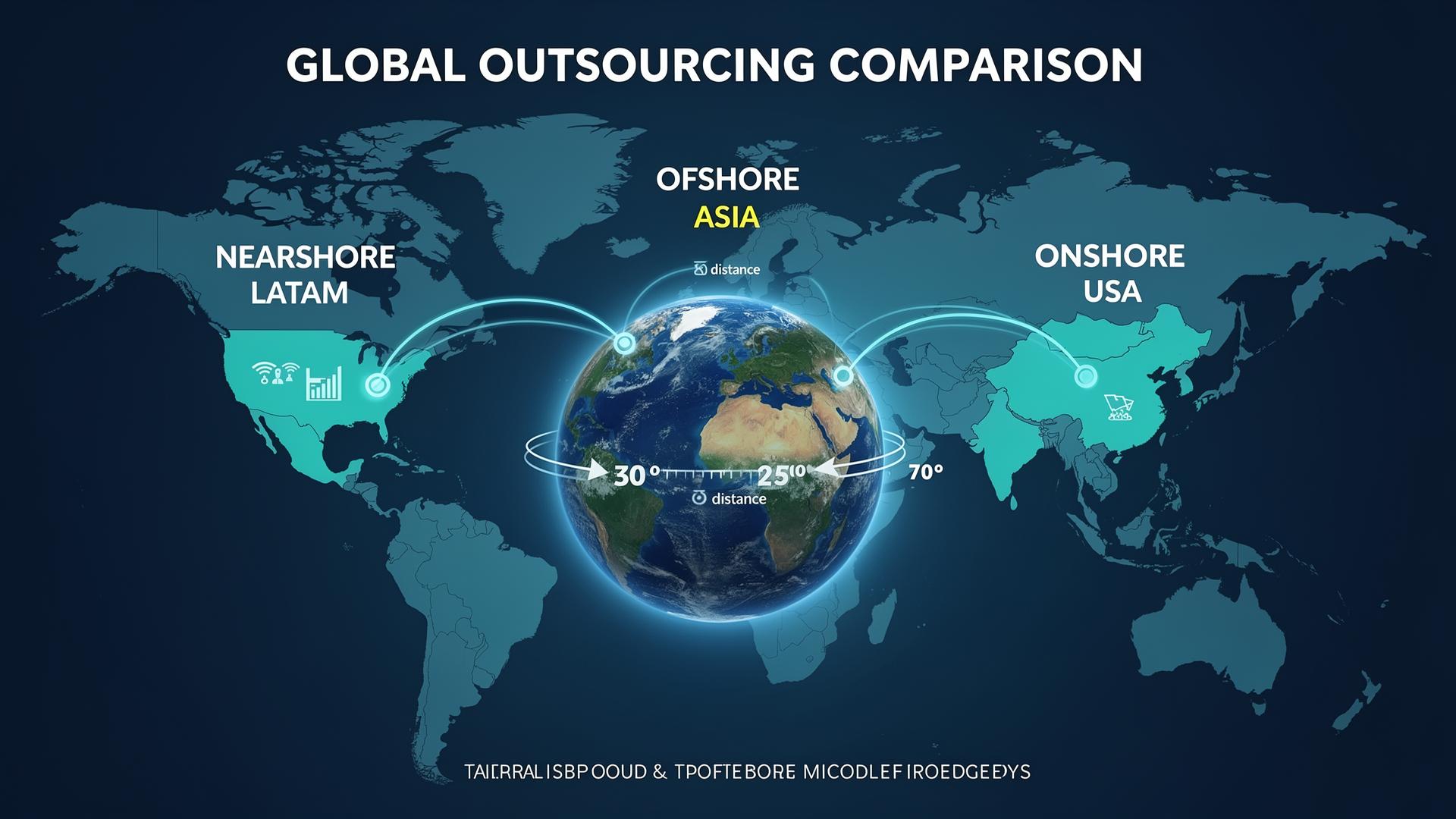
The migration of AI engineering talent sourcing from offshore (India, Eastern Europe) to nearshore (Latin America) is not a trend. It is a structural realignment driven by three forces that have compounded since 2022.
1. The timezone arbitrage is real and measurable. Research consistently indicates that for every hour of timezone separation, synchronous communication drops by approximately 11%. A team in Bangalore operates at a 10–12 hour offset from New York. A team in Buenos Aires operates at a 1-hour offset. That difference is the gap between "we had a great standup" and "I left a comment on the PR and hope they see it before tomorrow."
For AI engineering specifically — where architecture decisions, model evaluation, and prompt iteration require rapid feedback loops — same-day collaboration is not a luxury. It is a technical requirement.
2. The university pipeline has matured. Argentina's UBA, ITBA, and UTN. Brazil's USP and UNICAMP. Mexico's UNAM and ITESM. Colombia's Universidad de los Andes. These institutions have been producing strong STEM graduates for decades. In the last five years, dedicated AI, data science, and machine learning master's programs have proliferated across all four countries — producing graduates who are immediately productive in modern ML stacks (PyTorch, Hugging Face, LangChain, vector databases, RAG architectures).
Over 85,000 software and AI engineers graduate from LATAM universities each year, with the strongest concentrations in Brazil, Argentina, Mexico, and Colombia.
3. The cost differential is 60–70% on senior AI roles — and holding. Despite wage growth in LATAM tech markets since 2021, the differential remains structurally significant. The average salary for an AI/ML engineer in the United States is approximately $146,000 per year. A comparable role in Latin America ranges from $40,000 to $80,000 depending on country and specialization. For startups, this means the savings on a four-person AI team can exceed $400,000 per year — capital that directly extends operational runway.
LATAM Country-by-Country Intelligence: Where to Source What
Not all Latin American markets are interchangeable. Each country has distinct strengths that map to specific role types, budget constraints, and collaboration needs. The following analysis is grounded in HiresLink's internal placement data across 200+ searches, combined with publicly verified salary benchmarks from Q1–Q2 2026.
Quick Comparison Matrix
| Dimension | 🇦🇷 Argentina | 🇧🇷 Brazil | 🇨🇴 Colombia | 🇲🇽 Mexico |
|---|---|---|---|---|
| Senior AI Engineer (USD/yr) | $48,000–$66,000 | $55,000–$80,000 | $45,000–$65,000 | $50,000–$75,000 |
| Timezone Offset (from ET) | −1 to −2 hrs | −1 to −3 hrs | +0 to −1 hr | +0 to −2 hrs |
| AI/ML Talent Density | Highest in algorithms, data science, LLMs | Largest pool overall; strong NLP & Big Data | Growing in cloud, API architecture, software | Strong systems engineering, IoT, DevOps |
| English Proficiency | B2–C1 (high) | B1 (moderate) | B1–B2 (good spoken) | B2 (high in major hubs) |
| EOR/Legal Complexity | Low — flexible contractor & EOR structures | High — CLT labor law requires robust EOR | Low — favorable service export framework | Low — USMCA provides strong IP protection |
| Best Role Fit | Engineering, AI/ML, Product, Tech Lead | QA, mid-level dev, data analysis, support | Sales, BDR, CS, account management | DevOps, Ops, BizDev, enterprise roles |
Argentina: The AI Engineering Capital of LATAM
Argentina sits at the top of this analysis for deep technical engineering — specifically AI, ML, backend architecture, and technical leadership. This is not accidental. It reflects a 70-year tradition of rigorous mathematical and computer science education, compounded by an economic context that incentivizes top talent to seek USD-denominated remote work with US startups.
What we hire in Argentina (from HiresLink's active ATS):
- ML Engineers (Python, Data Science, Automation) — for AI-focused startups
- AI Evaluators / RLHF Specialists (LLM tuning, Research) — for model quality teams
- Python Backend Developers (Python, DevOps) — for stealth-stage product companies
- Senior Frontend Engineers (TypeScript, ReactJS, Vue.js, Node.js) — for insurance tech and SaaS platforms
- Senior Heads of Product (AI Specialist, BI, Research) — for consumer AI apps
- Product Designers (Figma, HTML, UX Research) — for remote-first product teams
- Tech Leads / IT Leaders — for ecommerce and scaling operations
Key salary benchmarks (Argentina, 2026, USD, contractor/EOR):
| Role | Monthly | Annual |
|---|---|---|
| Mid-level Engineer (3–5 yrs) | $2,500–$3,800 | $30,000–$45,600 |
| Senior Engineer (5–8 yrs) | $4,000–$5,000 | $48,000–$60,000 |
| Staff / Tech Lead (8+ yrs) | $5,000–$6,500 | $60,000–$78,000 |
| ML / AI Engineer (Senior) | $4,500–$5,500 | $54,000–$66,000 |
| Product Manager (Senior) | $4,000–$5,500 | $48,000–$66,000 |
| DevOps Engineer (Senior) | $3,800–$5,000 | $45,600–$60,000 |
Cultural operating characteristics: Argentine engineers push back on underspecified requirements — this is a feature for startups that need co-creators, not executors. They work async exceptionally well (Buenos Aires at ET−1 provides 7–8 hours of real-time overlap). They value technical complexity and learning; they'll stay longer on interesting problems. They receive direct feedback well, but context about the "why" behind changes accelerates adoption.
Brazil: Scale, Volume, and Mid-Level Depth
Brazil operates the largest tech talent market in Latin America by headcount. Its value for US startups is concentrated in mid-level engineering, QA, data analysis, and technical support — roles where volume, reliability, and process orientation matter more than architectural autonomy.
Where Brazil fits:
- QA Engineering (automated testing, Selenium, Cypress)
- Application Support (Tier 1–2, documentation, product onboarding)
- Mid-level Backend Development (Java, PHP, Python)
- Data Analysts and BI Engineers (SQL, Power BI, Tableau)
Salary benchmarks (Brazil, 2026, USD):
| Role | Monthly | Annual |
|---|---|---|
| Mid-level Engineer | $2,000–$3,200 | $24,000–$38,400 |
| Senior Engineer | $3,200–$4,200 | $38,400–$50,400 |
| QA Engineer (Senior) | $2,000–$3,200 | $24,000–$38,400 |
| Data / BI Analyst | $1,800–$3,000 | $21,600–$36,000 |
| Technical Support Lead | $1,500–$2,800 | $18,000–$33,600 |
Key consideration: Brazil's CLT (Consolidação das Leis do Trabalho) labor framework adds significant complexity. EOR support is not optional — it is required. Without a robust EOR partner, misclassification risk is high and the compliance burden is substantial.
Colombia: Revenue Teams and Customer-Facing Excellence
Colombia is HiresLink's primary recommendation for sales, business development, customer success, and account management roles targeting the US market. Bogotá and Medellín produce commercially trained, bilingual professionals with natural warmth and high emotional intelligence in customer interactions.
Where Colombia fits:
- SDR / BDR (outbound, US-facing SaaS)
- Account Executive (mid-market, relationship sales)
- Customer Success Manager
- Implementation Manager
- Head of Sales (commercial leadership)
Salary benchmarks (Colombia, 2026, USD):
| Role | Monthly | Annual |
|---|---|---|
| SDR / BDR | $1,200–$2,000 | $14,400–$24,000 |
| Account Executive | $2,000–$3,200 | $24,000–$38,400 |
| Customer Success Manager | $1,800–$3,000 | $21,600–$36,000 |
| Implementation Manager | $2,200–$3,500 | $26,400–$42,000 |
| Head of Sales | $3,500–$5,000 | $42,000–$60,000 |
Key advantage: Colombia's timezone matches US Eastern exactly (ET+0 for Bogotá for half the year), and the country's legal framework is highly favorable for service export. Free trade agreements simplify cross-border contractor arrangements.
Mexico: Enterprise-Ready, Timezone-Perfect
Mexico serves as the ideal LATAM market for roles requiring US cultural alignment, structured enterprise communication, and perfect Pacific/Central timezone overlap. USMCA (the successor to NAFTA) provides exceptional IP protection — making Mexico particularly attractive for companies in regulated industries.
Where Mexico fits:
- DevOps / Infrastructure (as seen in our CAT Squared placement — Application Support Lead with DevOps, QA, and Back-End skills at $2,000/month)
- Operations and Project Management
- Business Development (US or Mexican market)
- Technical Project Management
Key advantage: Strongest IP protection framework in LATAM via USMCA treaty.
Competitor Landscape: How Hiring Models Compare in 2026
The LATAM staffing market has matured significantly. For US companies evaluating options, understanding the structural differences between providers is more important than comparing logos.
| Dimension | BairesDev | Revelo | Near | HiresLink |
|---|---|---|---|---|
| Core Focus | Generalist software at scale (4,000+ engineers) | Marketplace for traditional software engineers | Remote talent across Tech, Marketing, Ops | AI/ML, Automation, and GTM specialists |
| Operating Model | Outsourcing + staff aug; devs remain BairesDev employees | Self-serve marketplace with EOR add-on | Talent matching for remote roles | Premium staff augmentation with rapid-deploy cells |
| Vetting Method | Algorithmic tests + CV review | Automated platform validation | Basic English + experience filter | Talent Intelligence Cards: architecture depth, AI logic, RAG pipeline review |
| Pricing | $50–$130/hr (top of LATAM market) | $35–$70/hr (marketplace rates) | $30–$55/hr | From $15/hr all-in; transparent flat fee, no surprises |
| Onboarding Speed | 3–6 weeks | 2–4 weeks | 1–3 weeks | First candidates in 5 business days; cohort-based team onboarding |
| EOR/Compliance | Handled internally (devs are their employees) | Available as add-on | Limited | Full EOR across Argentina, Colombia, Brazil, Mexico — included |
| Minimum Engagement | ~$50,000+ (enterprise-oriented) | No minimum | No minimum | No minimum — works with seed-stage through Series B |
| Ideal Client | Enterprise with budget for managed delivery | Self-serve teams hiring 1–2 devs | Companies filling general remote roles | VC-backed startups building AI/engineering pods |
The core differentiator: BairesDev operates at the top of the LATAM market on price, with bill rates 30–50% higher than leaner alternatives for comparable seniority. HiresLink inverts this model by offering AI-specialized talent at transparent, flat-fee pricing — with full EOR, HR, payroll, and compliance included rather than layered as add-on costs.
The Organizational Matrix: Who to Hire at Each Stage
For a CEO or CTO making headcount decisions, the question is not just "where to hire" but "which role type delivers the highest immediate impact given our company stage." The following matrix maps role types to company stage, cost, and use case.
| Role Type | Relative Cost | When to Hire | Immediate Impact | What You Need Internally |
|---|---|---|---|---|
| AI Engineer (RAG, vector DBs, backend integration) | High-LATAM premium ($4,500–$5,500/mo) | You need AI features embedded in your core product | Accelerates intelligent feature launches; strengthens backend architecture | CTO or Lead Architect to direct sprint integration |
| AI Specialist / Data Scientist (fine-tuning, model training) | Very high | You need proprietary models or deep research-grade ML | Long-term IP creation; differentiated model assets | Large clean datasets + GPU compute budget |
| AI Automation Specialist (n8n, Make, CrewAI, agents) | Moderate ($2,500–$4,000/mo) | You want to connect existing systems with intelligent automation | Immediate — automates complete workflows in days, not months | Clear SOPs, API access to current tools |
| AI-Augmented Ops Staff (EA, Finance, Support + AI tools) | Low ($1,200–$2,500/mo) | You need to scale execution without inflating headcount | Immediate — 3x productivity vs. traditional operators | Clear procedure manuals, explicit data handling policies |
The capital efficiency insight: Most Series A startups make the mistake of hiring an AI Specialist when they actually need an AI Automation Specialist. The first costs $6,000+/month and requires months to deliver value. The second costs $3,000/month and delivers automated workflows within weeks. Know which problem you are solving before choosing the role.
Compliance and Security: HIPAA, GDPR, and IP Protection in Cross-Border Teams
For companies in HealthTech, fintech, or any sector handling sensitive data, compliance is not an afterthought. It is a structural requirement that must be addressed before the first line of code is written by a nearshore team member.
HIPAA and Nearshore Teams
HIPAA regulations extend to all organizations and their business associates that handle Electronic Protected Health Information (ePHI) of US citizens. This explicitly includes nearshore software developers working on healthcare applications. Compliance requires administrative safeguards (access policies, workforce training, BAAs), physical safeguards (secure work environments, equipment controls), and technical safeguards (encryption, access authentication, audit logging).
Working through an EOR partner like HiresLink addresses several compliance vectors simultaneously: BAA (Business Associate Agreement) execution, encrypted communication infrastructure, access control documentation, and audit trail maintenance. The alternative — managing compliance directly with individual contractors across four different Latin American legal jurisdictions — is a significant operational and legal burden.
IP Protection by Country
| Country | IP Framework Strength | Key Mechanism |
|---|---|---|
| Mexico | Strongest in LATAM | USMCA treaty provides enforceable IP protections equivalent to US standards |
| Argentina | Strong | International consulting contracts with explicit IP assignment clauses; flexible EOR |
| Colombia | Strong | Favorable service export framework; free trade agreements simplify contractor IP terms |
| Brazil | Moderate (requires care) | CLT framework complicates IP assignment; requires robust EOR with explicit IP clauses |
EOR as a Risk Mitigation Layer
Employer of Record services function as a legal buffer between the US company and the LATAM talent. The EOR becomes the legal employer in-country, handling payroll, tax withholding, benefits, and labor law compliance — while the US company maintains day-to-day operational management and IP ownership.
Through HiresLink's EOR, clients never need to establish a local entity in Argentina, Colombia, Brazil, or Mexico. One contract. One invoice. Full compliance.
The Financial Model: How Nearshore AI Teams Extend Runway
For a VC-backed startup with $6M in Series A funding, team composition decisions are runway decisions. Here is the direct comparison:
Scenario: Building a 7-Person AI Engineering Pod
US-Only Hiring:
| Role | US Annual Cost (Fully Loaded) |
|---|---|
| Tech Lead | $320,000 |
| 2× Senior Backend Engineers | $520,000 |
| ML Engineer | $290,000 |
| Senior Frontend Engineer | $260,000 |
| DevOps Engineer | $240,000 |
| Product Manager | $210,000 |
| Total | $1,840,000 |
HiresLink LATAM Team (same roles, same seniority):
| Role | Country | Annual Cost |
|---|---|---|
| Tech Lead | Argentina | $78,000 |
| 2× Senior Backend Engineers | Argentina | $120,000 |
| ML Engineer | Argentina | $66,000 |
| Senior Frontend Engineer | Argentina | $60,000 |
| DevOps Engineer | Mexico | $54,000 |
| Product Manager | Argentina | $60,000 |
| Total | $438,000 |
Annual savings: $1,402,000. Runway extension: 11+ additional months at the same burn rate.
This is not theoretical. It is the arithmetic that drives nearshore hiring decisions for every capital-efficient startup in 2026.
HiresLink: The Full-Stack Nearshore Partner
HiresLink is not a marketplace. It is not a BPO. It is a full-stack nearshore partner built specifically for US technology companies scaling AI, engineering, and GTM teams in Latin America.
What is included:
- Sourced and vetted AI, engineering, sales, and design talent from a database of 5,000+ pre-screened LATAM professionals
- Talent Intelligence Cards that evaluate architecture depth, AI reasoning, and production experience — not just algorithm tests
- Full EOR across Argentina, Colombia, Brazil, and Mexico — zero entity setup required
- Payroll, HR, PTO management, performance reviews, and offboarding
- Coworking access across Buenos Aires, Bogotá, and São Paulo for distributed teams
- Team onboarding events and culture-building offsites
- Transparent flat-fee pricing — no percentage-of-salary models, no hidden markups
- Easy buyout option — if you want to convert a contractor to direct hire, the process is straightforward
Operational benchmarks:
- First candidate profiles delivered: 5 business days
- Average time-to-hire: 2–4 weeks
- Client savings vs. US equivalent: 55–70%
- 60-day replacement guarantee on all placements
Frequently Asked Questions
How quickly can I scale a team after a funding round? HiresLink operates cohort-based onboarding designed for post-raise scaling. We have deployed complete 4–6 person engineering cells within 30 days of engagement. The bottleneck is typically the client's interview bandwidth, not candidate sourcing.
Does HIPAA compliance work with nearshore teams? Yes, with proper infrastructure. HiresLink's EOR includes BAA execution, encrypted communication setup, access control documentation, and audit trail maintenance. Our HealthTech clients operate fully HIPAA-compliant distributed teams across Argentina, Colombia, and Mexico.
What about timezone overlap with the West Coast? Buenos Aires is PT+4 during standard time. Argentine engineers frequently adjust to a 6AM–3PM local schedule for West Coast overlap, providing 5–6 hours of real-time collaboration. Mexico (CDT/PDT) provides near-perfect Pacific timezone alignment.
How does your vetting compare to algorithmic testing platforms? Standard algorithmic tests (LeetCode-style) measure coding speed, not AI engineering competence. Our Talent Intelligence Cards evaluate architecture decision-making, RAG pipeline design, LLM integration depth, and async communication quality — the skills that actually predict production performance in AI teams.
What if a hire does not work out? 60-day replacement guarantee. No additional fee. No questions.
Next Step
If you are building an AI product, scaling an engineering team post-raise, or evaluating whether nearshore staffing makes financial and operational sense for your company — we should talk.
HiresLink will match your roles to the right LATAM country, deliver vetted candidate profiles within 5 business days, and have your first interviews scheduled within two weeks.
Start Your Search → hireslink.com
Data sourced from HiresLink internal ATS (200+ active and historical searches, 2022–2026), Howdy verified salary benchmarks (12,500+ payroll records), Glassdoor/SalaryExpert 2026 data, and publicly available market research. Salary ranges reflect all-in contractor costs in USD unless otherwise noted.
About HiresLink Team
Expert insights from the HiresLink team on hiring LATAM tech talent, remote work, and building distributed teams.
Table of Contents
Related Articles

Ready to Hire Top LATAM Talent?
Get matched with pre-vetted developers, designers, and specialists in 5 business days.