How to Integrate AI in Your Tech Recruitment Process
AI integration in tech recruiting: automated screening, matching algorithms, AI assessments and predictive analytics for effective hiring.
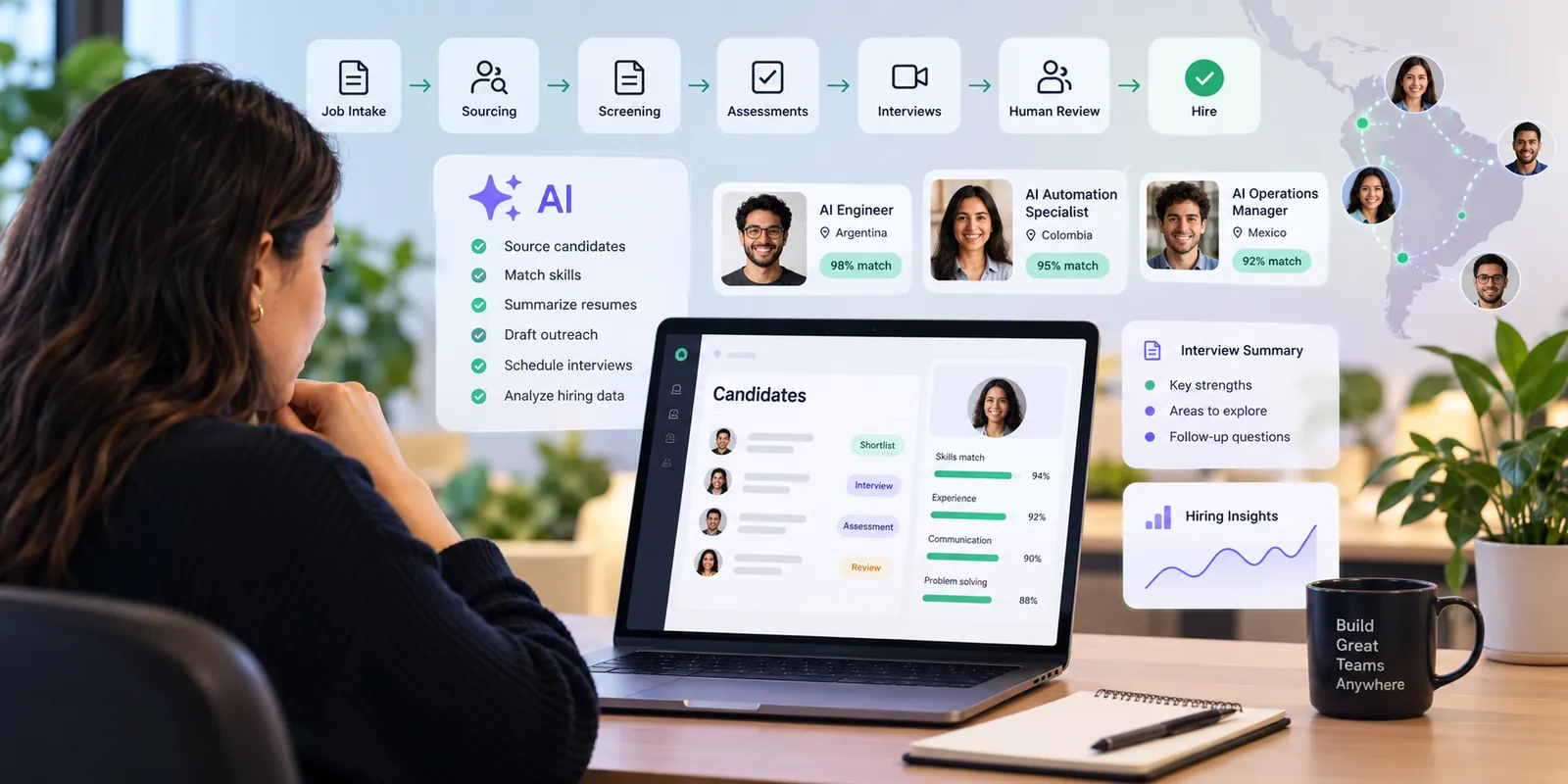
Quick Answer: The best way to use AI in recruitment in 2026 is to automate repetitive work without outsourcing judgment. Use AI for job intake, sourcing, candidate matching, scheduling, structured screening, assessment support, interview notes, and recruiting analytics. Keep humans responsible for role criteria, edge cases, accommodations, bias checks, interviews, and the final hiring decision.
AI is already part of modern recruiting. Teams use it to write job descriptions, search talent pools, personalize outreach, summarize resumes, coordinate interviews, and analyze hiring data. LinkedIn's latest Future of Recruiting report found that 37% of recruiting organizations were actively integrating or experimenting with generative AI.
The goal, however, should not be to automate every step. It should be to identify which parts of hiring benefit from speed and which still require human judgment.
This guide covers a practical AI recruiting workflow, implementation stack, costs, risks, human review, and an AI hiring checklist.
Target keywords: AI in recruitment, AI recruiting, AI recruitment process, how to use AI in recruitment, AI hiring tools, AI sourcing, AI candidate screening, AI recruiting workflow, AI recruiter, AI interview intelligence, AI hiring 2026
What AI in recruitment actually means in 2026
AI recruiting is not one tool.
It is a layer that can sit across several parts of the hiring funnel:
| Recruiting stage | Where AI can help | Where humans should stay involved |
|---|---|---|
| Role intake | Turn notes into a structured scorecard and draft job description | Define real must-haves, seniority, budget, and business outcomes |
| Sourcing | Search larger pools, identify adjacent skills, build prospect lists | Check relevance, diversity of sources, and candidate context |
| Outreach | Draft and personalize messages | Approve tone, claims, compensation, and high-value outreach |
| Screening | Summarize resumes and compare evidence against a scorecard | Review edge cases and avoid automatic rejection based only on an AI score |
| Assessments | Generate role-specific questions, help review structured outputs | Validate that the assessment is job-related and accessible |
| Interviews | Transcribe, summarize, organize evidence, flag unanswered topics | Conduct the interview, probe nuance, and evaluate communication in context |
| Selection | Aggregate structured evidence | Make the final decision and document the rationale |
| Analytics | Track funnel conversion, source quality, time-to-hire, and bottlenecks | Decide what metrics matter and investigate unexpected disparities |
A useful rule is simple: AI should organize evidence, not become the evidence. If a score influences rejection, the company should be able to explain what it measured and whether a person reviewed the decision.
A practical AI recruiting workflow
1. Start with a structured role brief
Do not begin by asking an AI tool to "find the best candidate." Start by defining the job.
Create a scorecard with:
- 3–5 measurable outcomes for the first 6–12 months
- Must-have skills versus trainable skills
- Required seniority
- Time-zone or language requirements
- Compensation range
- Evidence required at each interview stage
AI can turn hiring-manager notes into a structured brief and draft the job description. The hiring manager should still own the final criteria.
This is especially important for AI roles where titles overlap. An "AI Engineer," "AI Automation Specialist," and "AI Operations Manager" may describe very different work. HiresLink's AI Specialists pages and 2026 LATAM salary benchmarks can help teams compare scope, seniority, and compensation before sourcing begins.
2. Use AI to expand sourcing, not narrow it too early
AI-assisted sourcing works best when it finds relevant people beyond an exact job title.
For example, a company hiring an AI automation specialist may search for experience with n8n, Make, Zapier, APIs, CRM automation, workflow design, OpenAI integrations, and operations systems rather than only the title "AI Automation Specialist."
HiresLink's YC Talent Map can help teams explore where high-growth companies are building distributed workforces before choosing markets to target.
Avoid turning the sourcing model into a hidden gatekeeper. If it learns only from previous hires, it can repeatedly favor the same profile patterns.
3. Use AI for first-pass screening with human review
Resume summarization can save time. Fully automated rejection is more sensitive.
A safer process is:
- AI extracts evidence related to the approved scorecard.
- Candidates are grouped into clear matches, unclear cases, and clear misses.
- A recruiter reviews unclear cases and samples the other groups.
- Rejection reasons are tied to job-related criteria, not a generic model score.
- The company periodically checks whether the process creates unexpected disparities.
The U.S. Equal Employment Opportunity Commission has made clear that employment discrimination laws still apply when software, algorithms, or AI influence hiring. The EEOC has highlighted adverse impact under Title VII and the risk that automated tools can screen out people with disabilities under the ADA. See the EEOC's AI and ADA resources and its discussion of AI in employment selection procedures.
4. Make assessments more structured
AI can help create role-specific assessments when the test reflects the actual work.
A backend developer might complete a debugging exercise. An AI automation specialist could map a broken workflow and explain authentication, retries, human approvals, logging, and failure states. An operations hire could prioritize a messy process and write a short SOP.
AI can generate question variations and summarize submissions, but humans should verify the result against a clear rubric.
5. Use interview intelligence for documentation
Interview intelligence tools are useful for transcription, structured notes, question coverage, follow-up reminders, and evidence mapped to the scorecard.
The safer use case is helping interviewers remember what was said. The riskier use case is trying to infer personality, honesty, emotion, "culture fit," or future performance from facial expressions or voice patterns.
Treat AI-generated interview summaries as notes to verify, not as the final evaluation.
6. Automate recruiting operations around the decision
A large share of recruiting work is coordination rather than judgment, making it one of the lower-risk areas to automate.
Examples include scheduling interviews, creating ATS records, triggering scorecards, sending reminders, posting Slack updates, updating dashboards, and generating offer checklists.
Teams with complex hiring operations can use an AI Automation Specialist to connect the ATS, calendar, Slack, email, forms, assessment tools, and reporting layer without automating the final hiring decision.
What should your AI recruiting stack include?
A practical stack usually has seven layers:
| Layer | Purpose | Typical examples |
|---|---|---|
| ATS | System of record for candidates and stages | Your existing ATS |
| Sourcing | Find relevant candidates and adjacent skill matches | Talent databases, professional networks, AI sourcing tools |
| Outreach | Draft and personalize recruiter messages | AI writing inside sourcing or CRM tools |
| Screening | Extract evidence and compare against a structured scorecard | ATS AI features or controlled internal workflows |
| Assessment | Evaluate job-related work samples | Technical, writing, operations, or role-specific assessment platforms |
| Interview intelligence | Transcription, notes, scorecard support | Meeting and interview intelligence software |
| Automation + analytics | Connect systems and measure funnel performance | n8n, Make, Zapier, BI tools, spreadsheets, data warehouse |
Start with the tools you already have. Before buying another platform, check whether your ATS already includes AI-assisted sourcing, matching, summaries, scheduling, or analytics.
Extra tools can create duplicate records, inconsistent scoring, and more data risk.
How much does AI recruiting cost?
AI recruiting vendors price differently, including per seat, per job, per candidate, usage credits, subscriptions, or enterprise contracts.
Instead of expecting one standard software cost, budget by capability.
Lean recruiting team
Use the existing ATS, one sourcing platform, a general AI assistant, and simple workflow automation.
Much of the cost is recruiter time and software the company may already be paying for.
This can work well when hiring volume is relatively low and the main objective is removing repetitive administrative work.
Scaling recruiting team
As hiring increases, teams may add:
- Specialized AI sourcing tools
- Automated outreach
- Candidate assessments
- Interview intelligence
- Workflow automation
- Recruiting analytics
At this stage, integration and governance matter almost as much as individual software licenses.
A stack with five different AI tools is not necessarily better than one well-connected workflow.
High-volume or enterprise recruiting
Larger companies should also budget for:
- Security review
- Data-retention controls
- Vendor due diligence
- ATS integrations
- Bias testing where required
- Recruiting analytics
- Legal and compliance review
The real cost of an AI recruiting system is therefore not just the subscription fee.
Companies can also build internal capability instead of buying every function as software.
HiresLink currently publishes LATAM benchmarks of about $29–$39/hour for AI-powered recruiters, $29–$39/hour for AI Operations Managers, and roughly $3,500–$7,500/month for AI Automation Specialists, depending on experience and scope.
Compare current figures in the LATAM Talent Intelligence Report and HiresLink's role-specific hiring pages before setting a budget.
An AI-powered recruiter is useful when the bottleneck is sourcing, outreach, pipeline management, and candidate coordination.
An AI Operations Manager makes more sense when the company needs someone to own workflows, tools, process quality, and adoption across a larger recruiting operation.
And an AI Automation Specialist can help when the main challenge is connecting tools and removing manual processes across recruiting.
AI recruiting risks you should address before launch
AI recruiting can improve efficiency, but companies should understand what happens when an automated system influences who gets considered for a job.
Bias and adverse impact
AI can scale a biased process just as easily as it can scale a good one.
If historical hiring data disproportionately favors a particular profile, an AI system trained on that pattern may reproduce it.
Companies should:
- Use job-related criteria
- Document how automated tools influence decisions
- Test hiring-funnel outcomes by stage
- Review unexpected rejection patterns
- Maintain an escalation route for candidates who may have been incorrectly screened
- Avoid relying on unexplained "fit" or suitability scores
Human review does not automatically remove bias either. The goal is to create a structured process where both human and automated decisions can be examined.
Disability and accessibility
The EEOC warns that automated assessments can disadvantage applicants with disabilities if a tool measures something other than their ability to perform the job.
For example, a timed assessment or video-based interview system may unintentionally create barriers for some candidates.
Provide a clear accommodation process and an alternative assessment where appropriate.
Local AI hiring laws
Rules increasingly vary by jurisdiction.
New York City's Local Law 144 requires certain automated employment decision tools to undergo bias audits and requires notices before covered use.
Colorado's revised automated decision-making law is scheduled to take effect on January 1, 2027.
Employers hiring across multiple states should therefore check where candidates are located and what rules apply before deploying automated selection tools.
This article provides general information and is not legal advice.
Privacy and security
Recruiting data can include:
- Resumes
- Contact information
- Interview recordings
- Compensation details
- Work samples
- Assessment results
- Hiring-manager notes
Before connecting this information to an AI system, confirm:
- What candidate data the vendor stores
- How long it retains that data
- Whether customer data is used for model training
- Where the information is processed
- Who can access interview recordings
- Whether candidate information can be deleted
- What happens when the company stops using the platform
The NIST AI Risk Management Framework is a useful starting point for managing AI risk as an ongoing process rather than treating it as a one-time procurement check.
How HiresLink combines AI with human recruiting
A practical AI recruiting process does not need to be fully automated.
HiresLink's hiring and vetting process uses technology to search and organize a large LATAM candidate network, followed by human review, live interviews, technical evaluation where relevant, and client interviews before a hire is made.
The process works because technology and recruiters handle different parts of the workflow.
- Technology helps search, match, organize, and move faster.
- Recruiters verify communication, experience, motivation, and role fit.
- Technical evaluation checks job-specific capability where required.
- Clients interview finalists and make the hiring decision.
This matters especially when hiring specialized AI talent.
Searching thousands of profiles manually is inefficient.
Automatically assuming the highest-scoring profile is the best hire is risky.
The better model is to use AI to narrow and organize the evidence while experienced recruiters investigate the details that determine whether someone can actually succeed in the role.
For companies that do not want to build the entire workflow internally, HiresLink's Headhunting service follows a role brief, targeted sourcing, vetting, shortlist, interview, and close process.
The same structure can be adapted by an internal recruiting team using its own ATS and AI tools.
How to measure whether AI is actually improving recruitment
Do not measure success by how many recruiting tasks were automated.
Measure whether the hiring system improved.
Useful metrics include:
Time to shortlist
How long does it take to move from approved role to qualified candidates?
If AI sourcing works correctly, this number should improve without lowering candidate quality.
Recruiter hours per hire
Track how much time recruiters spend on sourcing, screening, scheduling, interviewing, and administration.
The purpose of automation should be to shift time away from repetitive work and toward candidate and hiring-manager conversations.
Interview-to-offer ratio
If AI improves candidate matching, recruiters should ideally send fewer poorly matched candidates into interviews.
Offer acceptance rate
Faster sourcing is not valuable if candidates repeatedly reject offers because compensation, role expectations, or communication were poor.
Source quality
Compare candidates by source.
AI sourcing may uncover channels that traditional recruiting searches miss.
Candidate experience
Track response times, interview delays, communication quality, and candidate feedback.
Automation that creates a faster but colder recruiting process can still damage hiring outcomes.
Quality after hire
Where possible, compare recruiting decisions with probation completion, manager satisfaction, retention, and early performance.
Be careful not to reduce "quality of hire" to a single automated number.
Where AI recruiting is heading next
Recruiting AI is moving from individual assistants toward connected workflows.
Instead of recruiters separately asking one tool to write a job description and another tool to summarize a resume, more systems are beginning to coordinate actions across the funnel.
A future recruiting workflow could:
- Receive a hiring-manager brief.
- Compare the budget with current salary data.
- Generate a structured scorecard.
- Identify suitable talent markets.
- Search internal and external candidate pools.
- Personalize outreach.
- Schedule responses.
- Summarize candidate evidence.
- Update the ATS.
- Prepare interview notes.
- Track hiring metrics.
The technical capability already exists for many of these steps.
The more important question is where the company wants a human to approve, review, or override the system.
That is why roles such as AI Operations Specialists, AI recruiters, and automation specialists are becoming more relevant.
Companies need people who understand both the automation and the business process around it.
HiresLink's Talent Intelligence data can also help companies compare emerging role demand, compensation, and talent availability across Latin America before determining where to build these teams.
For a broader view of where companies are already distributing their workforces, the HiresLink YC Talent Map provides data on thousands of Y Combinator companies and their international talent footprints.
The HiresLink Hiring Watch also tracks changes in U.S. hiring and LATAM talent economics as these patterns evolve.
AI recruiting implementation checklist
Before adding AI to your recruitment process, confirm that you can answer yes to the following:
- We have a written role scorecard before using AI to rank candidates.
- Every automated screening criterion is connected to the actual job.
- A human reviews borderline or ambiguous candidates.
- We do not make final hiring decisions solely from an AI-generated score.
- Candidates have a way to request an accommodation or alternative assessment.
- We know what candidate data each AI vendor stores and for how long.
- We have reviewed applicable federal, state, and local hiring rules.
- Interviewers use the same structured criteria rather than relying on vague "fit."
- We periodically check funnel outcomes for unexpected disparities.
- AI-generated notes, summaries, and recommendations can be corrected by a person.
- We track whether AI is improving quality, speed, candidate experience, or cost instead of assuming that more automation is better.
Frequently asked questions
How is AI used in recruitment in 2026?
AI is used for sourcing, job-description drafting, outreach personalization, resume summarization, candidate matching, scheduling, assessment support, interview transcription, recruiting analytics, and workflow automation.
The strongest implementations use AI for repetitive and evidence-organizing work while keeping people responsible for judgment-heavy decisions.
Should AI screen resumes automatically?
AI can extract and organize relevant resume information, but fully automatic rejection creates more risk.
Use a structured scorecard, human review for unclear cases, documented rejection criteria, and regular checks for adverse impact.
Can AI conduct job interviews?
AI can support interviews through scheduling, question generation, transcription, and structured summaries.
Companies should be cautious about allowing AI to independently evaluate candidates or infer personality, emotion, honesty, or "culture fit" from video or audio signals.
What is the biggest risk of AI in recruiting?
One of the biggest risks is scaling an unclear or biased hiring process.
If the underlying criteria are poor, AI can apply those criteria more quickly and across more candidates.
Data privacy, accessibility, local regulation, and over-reliance on opaque scores are also important concerns.
Do AI recruiting tools have to comply with employment law?
Yes.
Existing employment discrimination laws can apply when automated systems influence hiring, and some jurisdictions also have AI-specific rules.
Employers should review the locations where they hire and seek legal advice when automated tools materially influence candidate selection.
Will AI replace recruiters?
AI is more likely to change what recruiters spend their time doing than eliminate the need for recruiters entirely.
Activities such as searching databases, summarizing resumes, coordinating interviews, and updating systems can increasingly be automated.
Candidate judgment, hiring-manager alignment, persuasion, negotiation, relationship building, and complex hiring decisions still require significant human involvement.
The strongest recruiters will increasingly be the ones who know how to use AI while understanding where automation should stop.
Should we hire an AI recruiter or buy AI recruiting software?
Buy software when the recruiting process is already clear and the main need is speed or automation.
Hire an AI-enabled recruiter when the bottleneck is sourcing, outreach, candidate judgment, stakeholder management, or closing.
Hire an AI operations or automation specialist when the problem is connecting systems and redesigning the workflow itself.
Can small companies use AI in recruitment?
Yes.
Small companies do not need an expensive enterprise AI recruiting stack.
A basic combination of an ATS, sourcing tool, general AI assistant, calendar automation, structured scorecard, and human review can automate much of the administrative work without building a complicated system.
What recruiting tasks should not be fully automated?
Companies should be cautious about fully automating:
- Final candidate rejection
- Accommodation decisions
- Culture-fit judgments
- Personality assessments based on facial or vocal signals
- Compensation negotiations
- Final interviews
- Hiring decisions
These are areas where context, accountability, and human judgment remain especially important.
Final takeaway
AI can make recruiting faster in 2026, but speed should not be the main objective.
The goal is a hiring system that produces stronger evidence with less repetitive work.
Use AI to search wider, organize information, reduce coordination, and make structured recruiting easier.
Keep humans responsible for job criteria, context, accommodations, candidate conversations, edge cases, and the final decision.
For companies hiring across Latin America, AI can also make it easier to search a much larger regional talent market without manually reviewing thousands of profiles.
If your team is hiring AI, tech, operations, finance, legal, healthcare, or GTM talent in Latin America, explore HiresLink's pre-vetted LATAM candidate network, compare current compensation through the 2026 salary benchmarks, or review the LATAM Talent Intelligence Report before opening the role.
Sources
- LinkedIn — The Future of Recruiting
- U.S. EEOC — Artificial Intelligence and the ADA
- U.S. EEOC — AI and Employment Selection Procedures Under Title VII
- NYC Department of Consumer and Worker Protection — Automated Employment Decision Tools
- Colorado Attorney General — Artificial Intelligence
- NIST — AI Risk Management Framework
- HiresLink — Why HiresLink: Vetting & Hiring Process
- HiresLink — LATAM Talent Intelligence Report 2026
- HiresLink — LATAM Salary Benchmarks
- HiresLink — YC Talent Map
- HiresLink — Hiring Watch
About HiresLink Team
Expert insights from the HiresLink team on hiring LATAM tech talent, remote work, and building distributed teams.
Table of Contents
Related Articles
![Cost to Hire an AI Integration Engineer [2026]](https://www.hireslink.com/__l5e/assets-v1/abb858d5-756c-4eac-99ef-38a347595fbb/cost-to-hire-ai-integration-engineer.webp)
![10 Best Places to Hire AI Integration Engineers [2026]](https://www.hireslink.com/__l5e/assets-v1/32c31aca-65cc-4b90-8fb3-1aa35d920c3c/best-places-hire-ai-integration-engineers.webp)
Ready to Hire Top LATAM Talent?
Get matched with pre-vetted developers, designers, and specialists in 5 business days.