Jobs in 2026: What’s Growing as AI Reshapes Hiring
See which jobs are growing in 2026: BLS projects 5.9M new roles by 2035, while AI shifts demand toward data and judgment. Book a call in 48h.
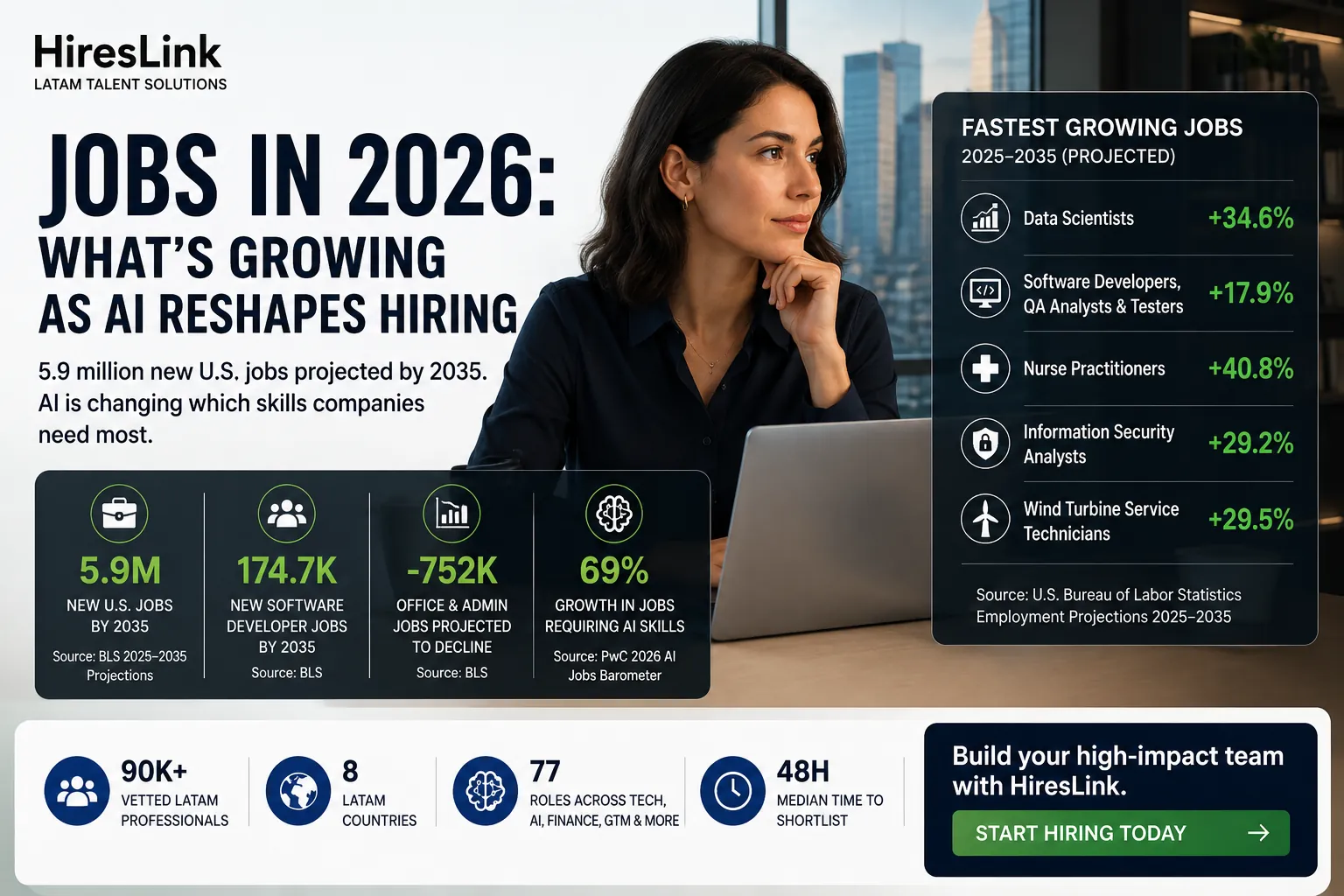
Quick Answer: The U.S. is projected to add 5.9 million jobs between 2025 and 2035, but growth is becoming increasingly concentrated. Data scientist employment is projected to rise 34.6%, software developers are expected to add 174,700 jobs, while office and administrative support occupations could lose 752,100 jobs. AI is not simply eliminating jobs—it is changing which skills companies pay for. For U.S. employers, that makes access to adaptable technical, AI, finance, and operations talent increasingly important. HiresLink provides access to 90,000+ vetted LATAM professionals, with median shortlists in 48 hours.
TL;DR — 7 numbers defining the jobs market in 2026
| # | Metric | 2026 value |
|---|---|---|
| 1 | Google Trends U.S. search volume for "jobs" on August 28 | 1K+ |
| 2 | New U.S. jobs projected from 2025–2035 | 5.9 million |
| 3 | Projected data scientist employment growth | 34.6% |
| 4 | New software developer jobs projected through 2035 | 174,700 |
| 5 | Office and administrative support jobs projected to disappear | 752,100 |
| 6 | Growth rate of jobs requiring specific AI skills in PwC's 2026 analysis | 69% |
| 7 | HiresLink median time from hiring brief to shortlist | 48 hours |
The keyword jobs began trending in the United States on August 28, 2026, reaching more than 1,000 searches in the latest Google Trends export.
Google Trends does not identify one specific article or event as the cause of that spike, but the timing coincides with two major labor-market developments.
First, the U.S. Bureau of Labor Statistics released its new 2025–2035 Employment Projections on August 27. The report projects that the U.S. economy will add 5.9 million jobs, taking total employment from 170.3 million to 176.2 million over the decade.
Second, investors and employers are already looking toward the next monthly employment report. Reuters reported on August 28 that economists expect approximately 45,000 jobs to be added in August, after payroll employment unexpectedly declined by 23,000 in July.
That combination creates what looks like a contradictory labor market.
Short-term hiring is soft.
Long-term demand for specific occupations remains strong.
AI is reducing the amount of labor required for some tasks while increasing demand for people who can build, operate, secure, analyze, and apply AI systems.
For founders and hiring leaders, the useful question is therefore not:
Are jobs disappearing?
It is:
Which jobs are becoming more valuable, and what skills should companies hire for now?
For U.S. companies looking beyond expensive domestic talent markets, HiresLink helps employers see all nearshore talent across technology, AI, GTM, finance, operations, and other functions in Latin America.
Why employers are looking at LATAM as the jobs market changes
The latest U.S. labor data does not point to a universal hiring boom.
It points to more selective hiring.
The BLS July 2026 employment report showed payroll employment falling by 23,000, while the unemployment rate remained approximately 4.1%. The August employment report is scheduled for September 4, and labor-market strength will be one of the biggest inputs into Federal Reserve and business planning decisions.
At the same time, the new BLS decade-long projections show that employers will still need millions of workers.
The difference is where the demand sits.
The BLS 2025–2035 projections estimate that professional, scientific, and technical services will grow 8.6%, adding approximately 926,700 jobs.
The agency specifically attributes part of that growth to demand for:
- AI-based systems.
- Research and development.
- Technology consulting.
- Digital infrastructure.
- Data-intensive business services.
Computer and mathematical occupations are projected to grow 7.3%, more than twice the 3.5% economy-wide rate.
For U.S. companies, this creates a talent allocation problem.
A founder may still need a software developer, Data Engineer, AI specialist, Operations Manager, or accountant, but the company may no longer be able to justify paying San Francisco or New York compensation for every position.
HiresLink's LATAM Talent Intelligence Report shows fully loaded LATAM hiring costs remain approximately 50–70% below equivalent U.S. roles at comparable seniority, while 72.6% of its vetted pool is verified at CEFR B2 English or higher.
That is why more companies are using staff augmentation to add specialist capacity while keeping leadership and product ownership inside the existing U.S. team.
Which jobs translate well to LATAM?
Strong fit
-
Software Developers — BLS projects software developers, QA analysts, and testers to generate approximately 106,100 openings per year through 2035. Backend, frontend, full-stack, mobile, QA, and cloud development translate particularly well to nearshore work because code, architecture, reviews, and deployments are already digital. Companies can hire nearshore developers across React, Python, Node.js, Java, Go, AWS, and other major stacks.
-
Data Scientists — BLS projects data scientist employment to increase 34.6% between 2025 and 2035, adding approximately 95,400 jobs. Data science works well remotely when the company provides secure access to relevant data, clear business questions, and defined evaluation standards. HiresLink's AI pool currently includes approximately 4,100 Data Scientists.
-
AI Integration Engineers — Companies increasingly need engineers who can connect OpenAI, Anthropic, Gemini, internal models, APIs, databases, CRMs, and existing software. HiresLink provides access to AI Integration Engineers for companies moving from isolated AI demos into production systems.
-
AI Operations Managers — As businesses run more AI workflows, somebody needs to own adoption, cost, reliability, vendors, evaluation, and business outcomes. Companies with several AI initiatives but no clear owner can use AI Operations Managers as the operational layer between leadership and engineering.
-
Operations Managers — BLS projects 181,300 additional general and operations manager jobs through 2035, one of the largest absolute increases across U.S. occupations. Nearshore Operations Managers can own reporting, workflows, vendor management, documentation, process improvement, and cross-functional execution.
-
Accountants and FP&A professionals — BLS projects accountants and auditors to add 79,400 jobs through 2035. AI is expected to automate more routine accounting work, but BLS explicitly says that this should make advisory and analytical responsibilities more prominent rather than eliminate overall demand.
-
Customer Success and GTM roles — Customer Success Managers, SDRs, growth marketers, and other client-facing roles remain strong nearshore fits when English proficiency and U.S. timezone overlap are screened properly.
Partial fit — smaller pool or local presence required
-
Licensed healthcare practitioners — Nurse practitioners are the fastest-growing occupation in the new BLS projections at approximately 41%, but most clinical jobs require U.S. licensing, credentialing, and physical presence. LATAM hiring is a stronger fit for healthcare billing, revenue-cycle management, administrative coordination, and other non-clinical functions.
-
Solar and wind technicians — Solar photovoltaic installers are projected to grow 36.5%, while wind turbine service technicians are projected to grow 29.5%. These jobs require physical access to equipment and therefore do not fit a fully remote nearshore model.
-
Construction trades — Construction laborers are expected to add more than 109,000 jobs, but field work must remain local. Remote estimating, CAD, BIM, project coordination, and administrative support can still be handled from LATAM.
-
Highly regulated executive roles — Some senior financial, legal, healthcare, or compliance positions require local licenses, board interaction, or jurisdiction-specific accountability. Nearshore professionals can support these teams without replacing locally accountable leadership.
The pattern matters.
AI is not making geography irrelevant.
It is making it easier to separate work that requires physical presence from work that requires expertise, communication, and secure system access.
2026 LATAM salary benchmarks — jobs growing with AI (USD/month, fully loaded via EOR)
| Role | Junior | Mid | Senior | Lead |
|---|---|---|---|---|
| Backend Developer | $2,200–$3,200 | $3,800–$5,000 | $6,200–$7,800 | $8,000–$10,000 |
| Data Engineer | $2,500–$3,500 | $4,400–$5,800 | $6,800–$8,800 | $9,000–$11,000 |
| Data Scientist | $3,500–$4,800 | $5,000–$6,500 | $6,800–$8,500 | $8,500–$10,500 |
| AI Integration Engineer | $4,000–$5,200 | $5,200–$6,800 | $6,800–$8,500 | $8,500–$10,500 |
| AI Product Manager | $3,800–$5,000 | $5,000–$6,500 | $6,500–$8,500 | $8,500–$10,500 |
| Operations Manager | $2,500–$3,400 | $3,400–$4,600 | $5,000–$6,500 | $6,500–$8,000 |
| Accountant | $2,000–$2,800 | $2,800–$3,600 | $4,000–$5,000 | $5,500–$7,000 |
| FP&A Analyst | $2,800–$3,600 | $3,400–$4,500 | $5,000–$6,200 | $6,500–$8,000 |
Figures are fully loaded planning ranges based on HiresLink Q2 2026 compensation benchmarks, current role pages, country-level salary variation, and typical EOR or compliant staffing costs. Final pricing depends on country, seniority, English proficiency, benefits, technical specialization, and employment structure.
HiresLink's published Q2 data provides useful reference points.
A mid-level Backend Developer benchmarks around $4,500/month, while a senior Backend Developer is approximately $7,200/month.
A mid-level Data Engineer benchmarks around $5,000/month, compared with approximately $8,000/month at senior level.
Senior Data Scientists average approximately $7,800/month, while senior AI Product Managers benchmark around $7,500/month.
For non-technical positions, HiresLink's current dataset lists a mid-level Operations Manager around $3,400/month, a mid-level U.S.-GAAP Accountant around $2,800/month, and an FP&A Analyst around $3,400/month.
The important point is not that every job should move to Latin America.
It is that employers can decide which roles truly require U.S. location and which primarily require strong skills, English, timezone overlap, and accountability.
US vs. LATAM — annual cost comparison
| Role | LATAM annual (mid, fully loaded) | U.S. annual equivalent | Annual savings |
|---|---|---|---|
| Backend Developer | $46K–$60K | $165K | $105K–$119K |
| Data Engineer | $53K–$70K | $175K | $105K–$122K |
| Data Scientist | $60K–$78K | $185K | $107K–$125K |
| AI Product Manager | $60K–$78K | $190K | $112K–$130K |
| Operations Manager | $41K–$55K | $125K | $70K–$84K |
| Accountant | $34K–$43K | $110K | $67K–$76K |
| FP&A Analyst | $41K–$54K | $135K | $81K–$94K |
A three-person team consisting of one Backend Developer, one Data Engineer, and one Operations Manager typically costs approximately $140K–$185K annually through LATAM hiring, compared with roughly $465K using the HiresLink U.S. equivalent benchmarks — an estimated annual difference of $280K–$325K.
U.S. comparisons use HiresLink's Q2 2026 benchmark dataset together with current U.S. labor-market compensation data. They are planning estimates, not guarantees for a specific city or candidate.
These savings matter more in a slower hiring market.
When companies are adding headcount selectively, every position has to justify its cost.
A company that can hire one excellent U.S. executive and surround that person with three strong nearshore specialists may have more operating leverage than a company attempting to hire every role locally.
Get the 2026 LATAM Talent Intelligence Report
90,000+ vetted candidates · 77 roles · 8 countries · Salary, supply, English, retention, and hiring-speed benchmarks.
What the new BLS jobs data actually says about AI
The most important change in the 2026 BLS projections is that the agency now explicitly publishes Artificial Intelligence Exposure Categories.
That is important because AI exposure does not automatically mean a job disappears.
BLS distinguishes between theoretical AI exposure—tasks AI could potentially assist with—and observed AI use in real occupations.
The agency also warns that the long-term employment effects remain uncertain.
The actual projections show three different outcomes.
1. Some AI-exposed jobs are growing rapidly
Data scientists are one of the clearest examples.
BLS projects data scientist employment to increase from approximately 275,600 jobs in 2025 to 371,000 in 2035.
That represents:
- 34.6% growth.
- Approximately 95,400 new positions.
- Around 24,800 openings per year, including replacement hiring.
- Median U.S. annual pay of $120,230 in 2025.
The BLS Data Scientist outlook explicitly says businesses will need these professionals as they integrate AI into workflows, business processes, product development, and decision-making.
Computer and information research scientists tell the same story.
Employment in that occupation is projected to grow approximately 21.8%, partly because businesses need people capable of developing new AI technologies.
2. Some occupations grow because AI makes experts more productive
Accountants provide a good example.
Routine accounting tasks are becoming easier to automate.
However, BLS still projects accountant and auditor employment to increase 5%, adding approximately 79,400 jobs.
Why?
The work shifts toward:
- Analysis.
- Advisory.
- Interpretation.
- Risk.
- Judgment.
- Business planning.
PwC's 2026 Global AI Jobs Barometer describes this as the professionalization effect.
AI automates lower-value work while increasing the value of the judgment-heavy parts of a profession.
PwC found that these professionalized roles are experiencing roughly twice the job growth and 42% faster wage growth than jobs where AI mainly makes the underlying role easier to perform.
3. Routine administrative work faces greater pressure
The clearest negative signal in the new BLS projections is office and administrative support.
Employment in the occupational group is projected to fall 4% from 2025 to 2035.
That translates into approximately 752,100 fewer jobs.
BLS specifically cites automation and AI-powered workflow tools as factors likely to reduce demand for some routine administrative functions.
This does not mean every administrative employee disappears.
It means a company may need fewer employees whose primary responsibility is:
- Copying data.
- Updating standard records.
- Scheduling routine activities.
- Preparing repetitive documents.
- Moving information between applications.
The administrative jobs that remain are likely to require more:
- Customer interaction.
- Judgment.
- Tool ownership.
- Process improvement.
- AI supervision.
- Coordination.
This is already visible in the types of people U.S. companies are hiring.
What companies say they need vs. what they actually hire
HiresLink's 2026 placement data shows a useful gap between AI job titles and actual business demand.
| What companies talk about | What they actually hired through HiresLink |
|---|---|
| "AI Agents" | Full-Stack Developer with LLM API experience — 22% of relevant placements |
| "LLM Researcher" | ML Engineer integrating OpenAI or Anthropic — 14% |
| "Computer Vision PhD" | Python Engineer with PyTorch — 4% |
| "Growth Hacker" | SDR + PPC Specialist combination — 11% |
| "Fractional CTO" | Senior Backend Engineer with light architecture ownership — 6% |
The lesson is simple.
Job titles change faster than underlying work.
A company may publish a role called AI Agent Engineer, but what it really needs is a strong Python or TypeScript developer who understands APIs, RAG, tool calling, evaluations, databases, and production reliability.
A company may think it needs a Chief AI Officer when the immediate bottleneck is simply that nobody owns five internal automation projects.
In that case, hiring an AI Operations Manager or using staff augmentation may solve the problem faster and at lower risk.
AI skills are growing much faster than the overall jobs market
The BLS projections show where employment may go over the next decade.
PwC's 2026 analysis shows what employers are asking for right now.
The PwC Global AI Jobs Barometer analyzed more than one billion job advertisements across six continents.
Its findings are difficult to reconcile with the idea that AI simply means fewer jobs.
Jobs requiring specific AI skills grew approximately 69%, compared with 9% growth across the broader jobs market.
That is almost eight times faster.
PwC also found:
- Workers with AI skills command an average 62% wage premium.
- Companies most able to use AI expanded headcount 52%, versus 36% at less AI-exposed companies.
- Wage growth at those companies was 24%, compared with 17%.
- The most AI-exposed entry-level roles are 7x more likely to demand traditionally senior skills such as leadership and judgment.
- AI-exposed entry-level roles grew 35% since 2019, while other entry-level positions declined approximately 10%.
That final point may be the most important for employers.
AI is removing some of the routine work junior employees traditionally performed while learning.
Employers are therefore expecting people to demonstrate:
- Judgment earlier.
- Stronger communication.
- Greater independence.
- AI literacy.
- Better problem-solving.
- Faster learning.
Hiring processes need to change with that reality.
Companies should test candidates on real situations rather than years of experience alone.
For example, ask a Data Engineer to diagnose an unreliable pipeline.
Ask an Operations Manager which three processes should not be automated.
Ask a developer to explain when a more powerful model is not worth the additional inference cost.
The best person for a 2026 job may not be the candidate with the longest resume.
It may be the person who can learn the fastest while still exercising good judgment.
Geographic breakdown — where LATAM talent comes from
| Country | Engineering pool | B2+ English | Strongest 2026 areas | U.S. timezone overlap |
|---|---|---|---|---|
| Argentina | ~24,000 | 78% | Tech, AI, design, automation | Excellent for ET |
| Brazil | ~31,000 | 61% | Engineering, fintech, cloud, data | Strong |
| Colombia | ~14,000 | 74% | Tech, GTM, healthcare, integrations | Excellent for ET |
| Mexico | ~11,000 | 72% | Finance, healthcare, GTM, enterprise tech | Excellent for CT/PT |
| Chile | ~5,200 | 76% | Engineering, FP&A, fintech | Strong |
| Uruguay | ~2,400 | 82% | AI, software, senior technical roles | Excellent |
| Peru | ~1,900 | 68% | Operations, support, development | Strong |
| Costa Rica | ~1,600 | 84% | Healthcare, GTM, technology | Excellent |
The largest talent market is not automatically the best one.
Brazil has the biggest technical pool in HiresLink's dataset, with approximately 31,000 developers.
Argentina has approximately 24,000, but a higher verified B2+ English rate at 78%.
Uruguay has a much smaller pool of approximately 2,400, but its 82% B2+ rate makes it attractive for senior or communication-heavy technology roles.
Mexico is particularly useful for companies hiring finance, healthcare, operations, or technical professionals who need close Central or Pacific Time collaboration.
Employers should therefore define the job first and the country second.
HiresLink's model lets companies see all nearshore talent rather than restricting the search to one market before understanding the available supply.
English proficiency — jobs in HiresLink's LATAM pool
| CEFR Level | Share |
|---|---|
| C2 (Mastery) | 6.8% |
| C1 (Advanced) | 38.4% |
| B2 (Upper-Intermediate) | 27.4% |
| B1 (Intermediate) | 20.2% |
| A1–A2 (Basic) | 7.2% |
72.6% are B2 or higher.
The appropriate English requirement depends on the job.
A Backend Developer with clear tickets, technical documentation, and an experienced Engineering Manager can usually operate successfully at B2.
A Customer Success Manager, Product Manager, AI Operations Manager, or senior consultant interacting directly with U.S. executives should usually be evaluated closer to C1.
HiresLink verifies English through live conversation rather than accepting a self-reported proficiency level.
That matters because successful remote hiring depends on more than vocabulary.
Companies should assess whether candidates can:
- Explain a problem.
- Challenge an assumption.
- Ask clarifying questions.
- Present bad news clearly.
- Document a decision.
- Communicate asynchronously.
Those skills become even more valuable as AI handles more routine work.
Seniority distribution — HiresLink talent pool
| Seniority | Share | Typical 2026 roles |
|---|---|---|
| Junior | 23% | Junior analysts, support, QA, implementation support |
| Mid-level | 46% | Developers, Data Engineers, accountants, CSMs, operations specialists |
| Senior | 25% | ML, DevOps, AI integrations, product, FP&A, operations leadership |
| Lead | 6% | Architects, Engineering Managers, senior AI and functional leaders |
The 46% mid-level concentration is particularly relevant to the current jobs market.
In a period of selective hiring, many companies do not need another vice president.
They need people with approximately three to six years of experience who can take independent ownership of a defined function.
That may be:
- A Data Engineer owning pipelines.
- A Backend Developer owning one product service.
- An accountant closing the monthly books.
- An Operations Manager owning reporting and workflow improvement.
- An AI Integration Engineer owning an internal automation stack.
Highly specialized leadership roles require a different process.
For these searches, companies can use headhunting pro for targeted sourcing, compensation benchmarking, references, and deeper leadership evaluation.
How compliance and EOR hiring work for LATAM jobs
Hiring someone from Latin America is legal when the relationship is structured correctly.
The main question is whether the person should be treated as:
- An independent contractor.
- An employee through an Employer of Record.
- An employee of the company's own LATAM entity.
- A worker supplied through a managed staffing model.
Employer of Record structure
An EOR is commonly used when a U.S. company wants a long-term employee in another country without establishing its own legal subsidiary there.
The local EOR or employment partner generally manages:
- Local employment contracts.
- Payroll.
- Employer contributions.
- Statutory benefits.
- Leave.
- Local employment records.
- Country-specific termination procedures.
The U.S. company still manages the person's daily work.
HiresLink operates its commercial and administrative structure through its U.S. Delaware entity, Bait INC, while local employment and EOR obligations are handled through the appropriate compliant employment structure for the candidate's country.
Independent contractors, W-8BEN, and 1099
Independent contractors can be appropriate for genuinely independent engagements.
Foreign individuals commonly provide Form W-8BEN to certify their foreign status for U.S. tax purposes.
That is different from issuing a domestic Form 1099 to a U.S. contractor.
Classification should reflect the real relationship.
If the company sets fixed hours, provides continuous supervision, expects exclusivity, and treats the worker exactly like an employee, an EOR or local employment arrangement may be more appropriate.
Companies should review HiresLink's employee versus contractor checklist and obtain legal or tax advice for the relevant jurisdiction.
IP and confidentiality
Remote jobs often involve access to:
- Source code.
- Customer records.
- Financial data.
- Internal processes.
- AI prompts.
- Product roadmaps.
- CRM records.
- Cloud systems.
Contracts should therefore clearly address:
- Work-product ownership.
- IP assignment.
- Confidentiality.
- Approved systems and accounts.
- Data handling.
- Subcontracting restrictions.
- Security incidents.
- Return or deletion of information at offboarding.
Technical controls
Legal documents should be supported with:
- Least-privilege access.
- Company-managed accounts.
- Multi-factor authentication.
- Logged production access.
- Secrets management.
- Formal onboarding and offboarding.
- Regular permission reviews.
Location does not remove the need for security.
The same controls should exist whether the employee works in Buenos Aires, Bogotá, Austin, or New York.
Case study — NYC SaaS company, 85 employees
An 85-person New York SaaS company was increasing its use of AI but did not want to add three additional U.S. technical salaries while growth remained uncertain.
The company had several disconnected AI pilots, 18 hours of manual reporting every week, and inconsistent customer-support triage.
It hired:
- One AI Operations Manager.
- One AI Integration Engineer.
- One AI Automation Specialist.
What happened:
- Intake call: 45 minutes
- Shortlist delivered: 48 hours
- Candidates presented: 3–5 per role
- Full team in place: Day 16
- Production workflows launched in 90 days: 9
- Manual reporting eliminated: 18 hours/week
- Support tickets automatically triaged: 42%
- Team retention: 12 months
The numbers:
- Annual LATAM team cost: $218,000
- Estimated equivalent U.S. hires, fully loaded: $512,000
- Annual savings: $294,000
The company did not use nearshore hiring simply to reduce salaries.
It used the cost difference to add a broader execution layer without adding the same amount of fixed U.S. payroll.
That distinction matters in the 2026 jobs market.
Selective hiring does not mean hiring nobody.
It means being more precise about the job, the required seniority, the location requirement, and the expected business outcome.
Vendor comparison — hiring LATAM talent in 2026
| Provider | Pool | Role coverage | Pricing model | EOR included | Best for |
|---|---|---|---|---|---|
| HiresLink | 90K+ vetted LATAM professionals | Tech, AI, GTM, finance, operations, healthcare, legal and more | Staff augmentation, managed staffing, direct hire | Available | U.S. teams building embedded nearshore teams |
| Near | Broad LATAM pool | Cross-functional business and tech roles | Recruitment and managed hiring | Available in some models | General LATAM hiring |
| Revelo | LATAM engineering marketplace | Primarily engineering and technical talent | Managed marketplace | Available in supported engagements | Individual software engineering hires |
| BairesDev | Large technical delivery organization | Engineering, data, software and AI | Outsourcing and staff augmentation | Managed through engagement | Large outsourced technical programs |
| Upwork | Global freelancer marketplace | Extremely broad, quality varies | Hourly or project pricing | No standard EOR | Short freelance projects with internal vetting |
HiresLink is most relevant when the company wants a professional embedded into the existing team rather than a disconnected outsourced project.
The current model includes:
- 90,000+ vetted candidates.
- 77 roles across eight LATAM markets.
- AI-assisted sourcing.
- Human screening.
- English verification.
- Technical or role-specific evaluation.
- 3–5 candidates on a typical shortlist.
- Median shortlist time of 48 hours.
- Payroll and compliance options.
Companies that already have strong internal managers can use staff augmentation.
Companies that want more employment, payroll, HR, and retention support can use managed nearshore staffing.
Frequently asked questions about jobs in 2026
Is it legal for U.S. companies to hire people from Latin America?
Yes. U.S. companies can hire LATAM professionals through an Employer of Record, compliant local employment structure, direct subsidiary, managed staffing arrangement, or genuine independent-contractor relationship. The correct model depends on the candidate's country, duration of employment, degree of control, and benefits structure.
How does an Employer of Record work for a LATAM hire?
An EOR becomes the worker's legal employer in the local country and handles payroll, statutory benefits, contributions, employment contracts, and local labor compliance. The U.S. company manages day-to-day responsibilities without opening its own subsidiary solely for the hire.
Why is "jobs" trending right now?
The latest Google Trends U.S. export shows jobs exceeding 1,000 searches on August 28, 2026. The export does not identify one specific trigger, but the spike comes one day after BLS released new 2025–2035 employment projections and as attention turns toward the August U.S. employment report due September 4.
Is the U.S. jobs market growing or shrinking?
Both signals exist at the same time. Payroll employment fell by 23,000 in July 2026, but BLS projects total U.S. employment to grow by 5.9 million jobs from 2025 to 2035. The larger change is that growth is increasingly concentrated in healthcare, technology, data, scientific, management, and other higher-value occupations.
Which jobs are growing fastest because of AI?
Data scientist employment is projected to increase approximately 34.6%, while computer and information research scientists are projected to grow about 21.8%. BLS also says AI demand will support employment growth across professional, scientific, technical, and computer-related services.
Which jobs are most exposed to AI automation?
Routine office and administrative support roles face some of the greatest projected pressure. BLS expects the group to decline approximately 4%, losing around 752,100 jobs from 2025 to 2035 as AI and automation take over more repetitive workflow tasks.
Is AI actually reducing tech jobs?
AI is changing tech jobs more than eliminating the entire category. BLS still projects 174,700 additional software developer jobs, while PwC found that jobs requiring specific AI skills are growing approximately 69%, almost eight times faster than the overall jobs market in its dataset.
Which AI skills are employers paying more for?
Machine learning, AI integrations, data engineering, MLOps, agent development, evaluation, automation, and AI product skills remain in demand. PwC's 2026 research found an average 62% wage premium for workers with AI skills.
What jobs are companies actually hiring through HiresLink?
HiresLink's 2026 placement data shows strong demand for software engineers, AI integrations, ML engineers, Data Engineers, AI Operations Specialists, SDRs, Customer Success Managers, finance professionals, and operations roles. In many cases, companies use simpler practical roles rather than the more aggressive AI titles initially discussed in job descriptions.
How much can a company save by hiring from LATAM?
HiresLink's Q2 2026 data shows fully loaded LATAM costs typically running 50–70% below equivalent U.S. compensation at comparable seniority. Exact savings depend on the role, country, English requirement, technical stack, and hiring structure.
Can LATAM employees work U.S. hours?
Yes. Most major Latin American talent markets fall within approximately zero to three hours of U.S. time zones. This gives companies substantial live overlap for meetings, customer calls, deployments, collaboration, and management.
How quickly can HiresLink provide candidates?
HiresLink's Q2 2026 dataset shows a median 48-hour time to shortlist and typical time-to-hire of approximately 5–7 days, depending on role complexity, interview availability, assessment requirements, and offer approval.
What does fully loaded cost mean?
Fully loaded cost includes the salary plus the relevant employer-side costs associated with payroll, benefits, compliance, EOR administration, or managed staffing. It is different from the candidate's take-home salary.
Get the 2026 LATAM Talent Intelligence Report
Real salary, supply, English, seniority, and hiring-speed data across 77 roles and 8 LATAM countries.
Ready to hire for the jobs your company actually needs in 2026?
Start Hiring → · Talk to an Expert →
Related HiresLink articles
- AI Jobs Companies Are Hiring For [2026]
- How to Hire AI Engineers From LATAM [2026]
- Top LATAM Countries to Hire AI Talent in 2026
- Best Places to Hire AI Operations Specialists in 2026
- Hiring in LATAM 2026: Complete Guide and Data
Relevant HiresLink pages
- AI specialists
- AI Integration Engineers
- AI Operations Managers
- hire nearshore developers
- staff augmentation
- managed nearshore staffing
- headhunting pro
- see all nearshore talent
- why HiresLink
- free resources
- start hiring
Sources
- Google Trends — Trending Now
- U.S. Bureau of Labor Statistics — Employment Projections 2025–2035
- U.S. Bureau of Labor Statistics — 2025–2035 Employment Projections Release
- U.S. Bureau of Labor Statistics — Artificial Intelligence Exposure Categories
- U.S. Bureau of Labor Statistics — Fastest Growing Occupations
- U.S. Bureau of Labor Statistics — Occupations With the Most New Jobs
- U.S. Bureau of Labor Statistics — Data Scientists
- U.S. Bureau of Labor Statistics — Software Developers, QA Analysts and Testers
- U.S. Bureau of Labor Statistics — Accountants and Auditors
- U.S. Bureau of Labor Statistics — Current Population Survey
- Reuters — Jobs Report and Broadcom Results Are the Next Market Tests
- PwC — 2026 Global AI Jobs Barometer
- PwC — Two Futures for Jobs in an AI Era
- HiresLink — LATAM Talent Intelligence Report Q2 2026
- HiresLink — AI Specialists
- HiresLink — Nearshore Developers
- HiresLink — Staff Augmentation
Sources: Google Trends U.S. Trending Now export supplied August 28, 2026; U.S. Bureau of Labor Statistics 2025–2035 Employment Projections released August 27, 2026; BLS AI exposure, occupation, wage, and current employment data; Reuters labor-market reporting from August 28, 2026; PwC Global AI Jobs Barometer 2026; and HiresLink Talent Intelligence Report Q2 2026, based on 90,000+ vetted LATAM candidates, 280+ placements, 77 roles, and eight countries.
About HiresLink Team
Expert insights from the HiresLink team on hiring LATAM tech talent, remote work, and building distributed teams.
Table of Contents
Related Articles
![NVIDIA Earnings and AI Hiring [2026]](https://www.hireslink.com/__l5e/assets-v1/eb4b9e29-f168-4046-920b-b45d7a048e82/nvidia-earnings-ai-hiring-2026.webp)
![Dario Amodei's AI Hiring Test [2026]](https://www.hireslink.com/__l5e/assets-v1/717deb56-8f44-454b-8b43-b10a87afe9ff/dario-amodei-ai-hiring-test-2026.webp)
![Peter Thiel's $419M AI Power Bet [2026]](https://www.hireslink.com/__l5e/assets-v1/92cd48f8-77eb-441a-ae73-31061e8d6878/peter-thiel-ai-power-infrastructure-2026.webp)
Ready to Hire Top LATAM Talent?
Get matched with pre-vetted developers, designers, and specialists in 5 business days.