Peru Public Holidays 2026: Guide for US Employers
See Peru public holidays 2026 for US employers hiring remote teams. Includes national holidays, non-working days, payroll notes, EOR tips, and LATAM hiring guid
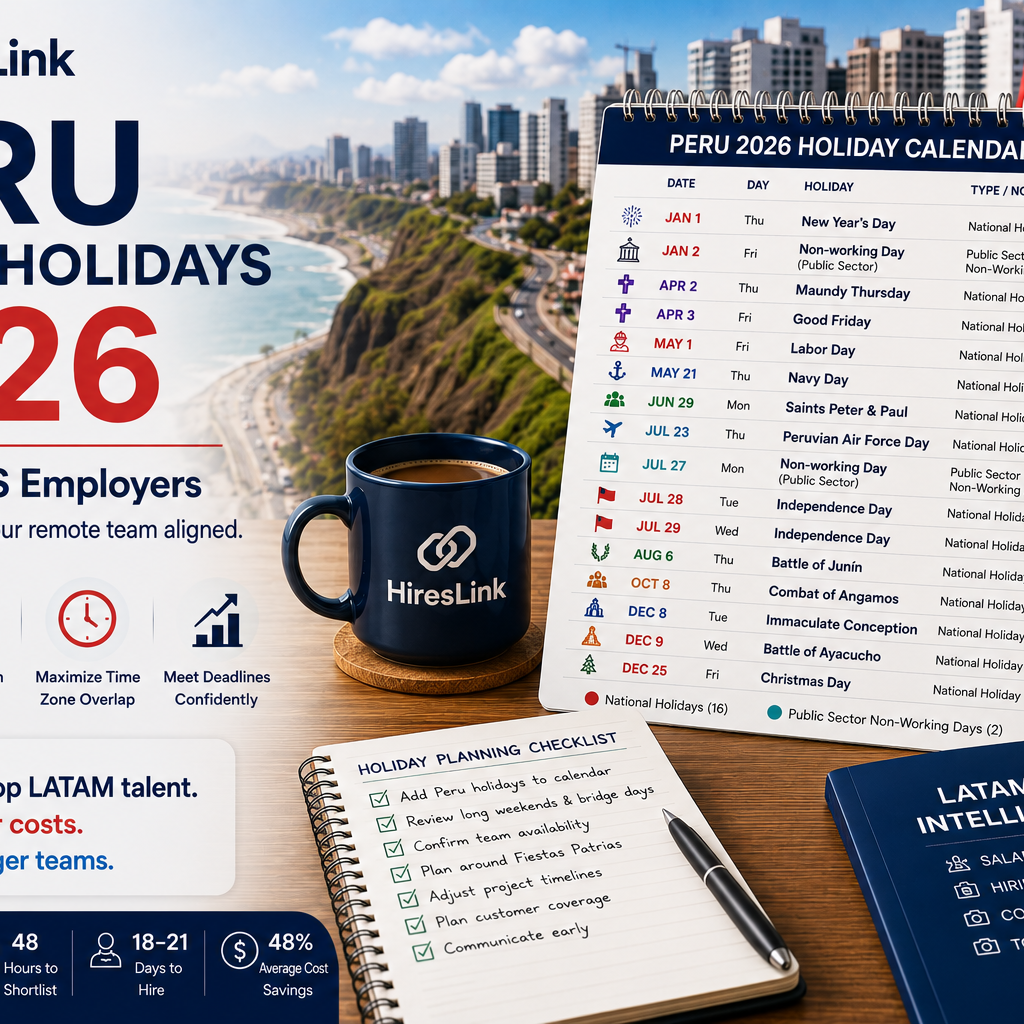
Quick Answer: Peru has 16 national public holidays in 2026, plus public-sector días no laborables such as January 2 and July 27. For US companies hiring remote talent in Peru, the biggest dates to plan around are Holy Week in April, Fiestas Patrias in July, Battle of Junín in August, Combat of Angamos in October, December 8–9, and Christmas week. HiresLink helps US companies hire from 90,000+ vetted LATAM candidates, deliver shortlists in 48 hours, and build remote teams with average 48% cost savings vs. equivalent US hires.
TL;DR — 7 numbers for Peru remote hiring in 2026
| # | Metric | 2026 value |
|---|---|---|
| 1 | Peru national public holidays in 2026 | 16 |
| 2 | Public-sector non-working days listed for 2026 | 2 |
| 3 | National holidays falling on weekdays in 2026 | 12 of 16 |
| 4 | Recommended planning buffer around Fiestas Patrias | 3–5 business days |
| 5 | Recommended daily US-Peru timezone overlap | 4–6 hours |
| 6 | Vetted candidates in HiresLink’s LATAM network | 90,000+ |
| 7 | Average HiresLink time from intake call to shortlist | 48 hours |
Why Peru public holidays matter for US remote teams
Peru is a useful LATAM market for US companies hiring remote talent, especially when timezone overlap, bilingual communication, operations support, customer service, finance support, and technical talent matter.
Peru’s timezone alignment with the US is one of its biggest advantages. A Peru-based remote hire can often overlap well with EST and CST teams, making it easier to run support coverage, sales calls, finance workflows, daily standups, and manager check-ins.
But Peru’s holiday calendar still needs to be planned properly.
The main issue is not just national holidays. Peru also has días no laborables, which are non-working days often declared for the public sector. These may not automatically apply to private-sector teams, but they can still affect banks, government offices, schools, local services, family plans, and employee availability.
For companies hiring a backend developer, AI automation specialist, customer support representative, SDR, executive assistant, or bookkeeper in Peru, holidays can affect:
- interview scheduling
- onboarding dates
- customer support coverage
- sprint planning
- finance close
- payroll and invoice approvals
- sales outreach calendars
- manager check-ins
- launch timelines
- EOR and contractor paperwork
For companies using managed nearshore staffing, staff augmentation, or headhunting pro, Peru holiday planning should be part of the remote operating system from day 1.
Peru public holidays 2026
The table below lists Peru’s national public holidays for 2026 based on the official gob.pe holiday calendar.
| Date | Day | Holiday | Type | Employer note |
|---|---|---|---|---|
| January 1, 2026 | Thursday | Año Nuevo / New Year’s Day | National holiday | Expect most teams offline |
| April 2, 2026 | Thursday | Jueves Santo / Holy Thursday | National holiday | Holy Week slowdown |
| April 3, 2026 | Friday | Viernes Santo / Good Friday | National holiday | Long weekend |
| May 1, 2026 | Friday | Día del Trabajo / Labor Day | National holiday | Long weekend |
| June 7, 2026 | Sunday | Batalla de Arica y Día de la Bandera | National holiday | Lower weekday impact |
| June 29, 2026 | Monday | San Pedro y San Pablo | National holiday | Long weekend |
| July 23, 2026 | Thursday | Día de la Fuerza Aérea del Perú | National holiday | Possible bridge-day requests |
| July 28, 2026 | Tuesday | Fiestas Patrias | National holiday | Major national holiday |
| July 29, 2026 | Wednesday | Fiestas Patrias | National holiday | Major national holiday |
| August 6, 2026 | Thursday | Batalla de Junín | National holiday | Possible bridge-day requests |
| August 30, 2026 | Sunday | Santa Rosa de Lima | National holiday | Lower weekday impact |
| October 8, 2026 | Thursday | Combate de Angamos | National holiday | Possible bridge-day requests |
| November 1, 2026 | Sunday | Día de Todos los Santos | National holiday | Lower weekday impact |
| December 8, 2026 | Tuesday | Inmaculada Concepción | National holiday | Midweek disruption |
| December 9, 2026 | Wednesday | Batalla de Ayacucho | National holiday | Back-to-back December holidays |
| December 25, 2026 | Friday | Navidad / Christmas Day | National holiday | Christmas week slowdown |
For US employers, the highest-impact periods are April, late July, early August, October, and December. These are the windows most likely to affect onboarding, support coverage, payroll timing, and sprint planning.
Peru public-sector non-working days 2026
Peru also has días no laborables, which are not the same as national holidays. These are often declared for public-sector workers and may apply to private-sector workers only by agreement.
| Date | Day | Occasion | Type | Employer note |
|---|---|---|---|---|
| January 2, 2026 | Friday | Public-sector non-working day after New Year | Día no laborable for public sector | Creates New Year long weekend |
| July 27, 2026 | Monday | Public-sector non-working day before Fiestas Patrias | Día no laborable for public sector | Creates extended Fiestas Patrias window |
For US companies, the practical point is simple: even when a día no laborable is not mandatory for private-sector workers, availability may still be lower. A Peru-based hire may need to manage school closures, bank delays, government office closures, travel, or family plans.
That is why the holiday policy should clarify whether these days are observed, worked normally, or handled through PTO.
Peru 2026 holiday calendar by quarter
Grouping the dates by quarter makes planning easier.
| Quarter | Key dates | Planning risk |
|---|---|---|
| Q1 | January 1–2 | New Year long weekend |
| Q2 | April 2–3, May 1, June 7, June 29 | Holy Week, Labor Day, and June long weekend |
| Q3 | July 23, July 27–29, August 6, August 30 | Highest planning risk because of Fiestas Patrias |
| Q4 | October 8, November 1, December 8–9, December 25 | October bridge risk and December slowdown |
Q3 is the most important period for US teams to review. If you are hiring, onboarding, launching, or closing a project with Peru-based talent, avoid treating late July as a normal workweek.
Why Fiestas Patrias matters for remote employers
Peru’s Fiestas Patrias period is the biggest planning point for US companies working with Peru-based team members.
In 2026, the core national holidays are:
| Date | Day | Holiday |
|---|---|---|
| July 28, 2026 | Tuesday | Fiestas Patrias |
| July 29, 2026 | Wednesday | Fiestas Patrias |
But the broader planning window can start earlier because:
- July 23 is a national holiday for Día de la Fuerza Aérea del Perú.
- July 27 is a public-sector non-working day.
- July 28–29 are national holidays.
- Many people may request time off around this period.
For remote teams, avoid scheduling major onboarding, production releases, customer handoffs, finance deadlines, or critical sales pushes during the late-July window unless availability is confirmed.
Peru holidays vs US holidays in 2026
Peru and the US share some holiday periods, but many key dates are different.
| Period | Peru impact | US impact | Planning note |
|---|---|---|---|
| New Year | High | High | Shared downtime |
| Holy Week | High in Peru | Varies by US company | Avoid major launches or onboarding |
| Labor Day | May 1 in Peru | September in US | Different dates |
| Fiestas Patrias | Very high in Peru | Low in US | Major Peru-only planning window |
| Thanksgiving | Low in Peru | High in US | Peru team may work while US team is offline |
| December 8–9 | High in Peru | Low in US | Back-to-back Peru holidays |
| Christmas | High | High | Shared slowdown |
This mismatch can help with coverage if handled thoughtfully. Peru-based hires may support some US-only holidays, while US managers should plan respectfully around Peru-only holidays.
How Peru holidays affect different remote roles
Holiday impact depends on the role. A developer, support rep, SDR, bookkeeper, and EA will not be affected in the same way.
| Role | Holiday planning impact | What to plan |
|---|---|---|
| Backend Developer | Sprint velocity and release windows may shift | Avoid releases before long weekends |
| AI Automation Specialist | Workflow testing and monitoring may slow | Avoid launching critical automations before holidays |
| Customer Support Rep | Coverage gaps may affect SLAs | Build backup support schedules |
| SDR / BDR | Prospecting volume and reply rates may dip | Adjust outbound targets around long weekends |
| Executive Assistant | Calendar management and travel planning increase | Confirm manager schedules early |
| Bookkeeper | Payroll, invoicing, and close timelines may shift | Move finance deadlines earlier |
For example, a Peru-based customer support representative may need backup coverage during Fiestas Patrias. A Peru-based backend developer may need sprint deadlines adjusted. An AI automation specialist may need someone available to monitor workflows if automations touch support, sales, finance, or customer systems.
How many hours of US-Peru overlap should you expect?
Peru is usually one of the easiest LATAM countries for US timezone alignment, especially for EST and CST teams.
For most roles, plan for 4–6 hours of daily overlap. That is usually enough for:
- standups
- support escalations
- sales calls
- manager check-ins
- code reviews
- onboarding sessions
- sprint planning
- customer meetings
- finance close reviews
- weekly planning
For software, AI, design, and documentation-heavy roles, a more async setup can also work well. For support, sales, executive assistant, finance, and operations roles, real-time overlap usually matters more.
If timezone overlap is central to your hiring plan, review the Hiring in LATAM 2026 guide and the LATAM Talent Intelligence Report.
2026 LATAM salary benchmarks — roles commonly hired from Peru and LATAM
| Role | Junior | Mid | Senior | Lead |
|---|---|---|---|---|
| Backend Engineer | $2,500–$3,800 | $3,800–$5,500 | $5,500–$7,000 | $7,000–$9,000 |
| AI Automation Specialist | $2,000–$3,000 | $3,000–$4,500 | $4,500–$6,500 | $6,500–$8,000 |
| Customer Support Representative | $1,200–$1,600 | $1,600–$2,200 | $2,200–$3,000 | — |
| SDR / BDR | $1,400–$1,800 | $1,800–$2,600 | $2,600–$3,500 | $3,500–$4,500 |
| Bookkeeper | $1,300–$1,800 | $1,800–$2,600 | $2,600–$3,400 | $3,400–$4,500 |
| Executive Assistant | $1,400–$1,900 | $1,900–$2,600 | $2,600–$3,400 | $3,400–$4,200 |
Figures are fully loaded: salary + EOR costs. No hidden fees.
Peru can be a strong market for operations, support, finance, sales, software, and bilingual coordination roles. But compensation should still be benchmarked by role, seniority, English level, city, timezone needs, and hiring model. Use the LATAM salary benchmark hub before setting final compensation.
US vs. LATAM — annual cost comparison for remote hiring
| Role | LATAM Annual, mid-level fully loaded | US Annual, mid-level fully loaded | Annual savings |
|---|---|---|---|
| Backend Engineer | $45,600–$66,000 | $125,000–$170,000 | $59K–$124K |
| AI Automation Specialist | $36,000–$54,000 | $95,000–$145,000 | $41K–$109K |
| Customer Support Representative | $19,200–$26,400 | $50,000–$68,000 | $24K–$49K |
| SDR / BDR | $21,600–$31,200 | $60,000–$95,000 | $29K–$73K |
| Bookkeeper | $21,600–$31,200 | $58,000–$82,000 | $27K–$61K |
| Executive Assistant | $22,800–$31,200 | $65,000–$95,000 | $34K–$72K |
3-person remote team example: a mid-level backend engineer, executive assistant, and customer support representative hired through LATAM typically costs $87K–$124K/year vs. $240K–$333K/year for equivalent US hires — a typical annual savings range of $116K–$246K.
US benchmarks are based on 2025–2026 market salary ranges and fully loaded employer cost assumptions.
Get the 2026 LATAM Talent Report
90K+ vetted candidates · salary data by role, seniority, and country · hiring trends across LATAM.
How to build a Peru holiday policy for remote teams
US companies should decide early whether Peru-based team members follow the US holiday calendar, Peru holiday calendar, or a blended policy.
A simple holiday policy should answer these questions:
| Policy question | Why it matters |
|---|---|
| Which holidays does the Peru-based hire observe? | Avoids confusion between US and Peru calendars |
| Are Peruvian national holidays paid time off? | Important for employees and EOR hires |
| Are public-sector non-working days observed? | January 2 and July 27 need clear expectations |
| Are US holidays also included? | Important for company-wide consistency |
| How are regional or local holidays handled? | Some local observances may affect availability |
| How should time off be requested? | Prevents last-minute schedule gaps |
| Who covers urgent work during holidays? | Protects support, sales, and operations continuity |
| How do holidays affect payroll or invoices? | Important for finance and contractor workflows |
This policy can sit inside your Remote Work Policy Template, Work From Home Policy Sample, or onboarding documents.
Peru holiday planning checklist for US employers
Use this checklist before hiring or onboarding Peru-based remote talent.
Peru Holiday Planning Checklist

Company: [Company Name]
Peru-based hire: [Name]
Role: [Role]
Manager: [Manager]
Year: 2026

Before offer:

[ ] Confirm whether the role follows US holidays, Peru holidays, or a blended policy
[ ] Confirm whether public-sector non-working days are observed
[ ] Confirm expected timezone overlap
[ ] Confirm whether customer coverage is required on holidays
[ ] Confirm whether the role is employee, EOR, contractor, or consultant
[ ] Confirm whether regional or local holidays may apply

Before onboarding:

[ ] Add Peru national holidays to the team calendar
[ ] Add Holy Week to the planning calendar
[ ] Add Fiestas Patrias to the planning calendar
[ ] Add public-sector non-working days
[ ] Add long weekends and possible bridge days
[ ] Confirm PTO and holiday request process
[ ] Confirm manager coverage expectations
[ ] Confirm backup owner for urgent work
[ ] Confirm payroll or invoice deadlines around holidays
[ ] Confirm tool access and escalation rules
[ ] Confirm how US-only holidays are handled

During the year:

[ ] Review holiday calendar every quarter
[ ] Check deadlines before long weekends
[ ] Avoid major launches during low-coverage periods
[ ] Confirm support coverage during Peru-only holidays
[ ] Confirm availability during US-only holidays
[ ] Update policy if EOR, contractor, or team structure changes
Best practices for managing Peru-based remote employees
1. Add Peru holidays to your shared calendar
Add Peru’s 2026 national holidays and public-sector non-working days to Google Calendar, Outlook, Notion, ClickUp, Jira, Linear, or whatever planning tool your team uses.
Do not expect the employee to remind the US team before every long weekend.
2. Plan around Holy Week
Holy Week in Peru includes April 2 and April 3 as national holidays in 2026. The broader week may also be slower for some people.
Avoid major onboarding, launches, migrations, or customer handoffs during that period unless coverage is confirmed.
3. Treat Fiestas Patrias as the biggest planning window
Late July is the most important holiday period to plan around in Peru.
In 2026, the combination of July 23, July 27, July 28, and July 29 creates an unusual work rhythm. US employers should confirm availability early and avoid assuming normal productivity that week.
4. Watch Thursday holidays
Peru has several Thursday holidays in 2026, including January 1, April 2, July 23, August 6, and October 8.
These can create bridge-day requests for Friday. If you are planning onboarding, releases, client handoffs, or finance deadlines, confirm Friday availability before assuming a normal week.
5. Separate national holidays from non-working days
A national holiday and a día no laborable are not the same. National holidays usually apply broadly, while non-working days may primarily apply to the public sector and may require agreement in the private sector.
This difference should be written clearly in your employee, contractor, or EOR workflow.
6. Confirm US-only holidays
Thanksgiving, July 4, Martin Luther King Jr. Day, Presidents’ Day, and Memorial Day may not be Peruvian holidays. Decide whether Peru-based hires work those days or receive them off as part of a company-wide policy.
7. Check payroll and invoice timing
If a holiday falls near the end of the month or on a Friday/Monday, make sure invoices, timesheets, payroll cutoffs, and approvals are handled early.
Peru vs other LATAM countries for US hiring
Peru can be a strong LATAM option for operations, customer support, finance, sales, and bilingual coordination roles.
| Country | Best for | Timezone fit for US teams | Holiday planning note |
|---|---|---|---|
| Peru | Operations, support, finance, sales, software, bilingual roles | Strong for EST/CST | Fiestas Patrias and Thursday holidays matter |
| Colombia | Support, sales, operations, finance, software | Excellent for EST/CST | Many Monday holidays / puentes |
| Mexico | Support, sales, operations, engineering, bilingual roles | Excellent for CST/PST, strong for EST | Several Monday holidays |
| Argentina | Engineering, AI, finance, operations, design, specialist roles | Strong for EST/CST | Carnival, tourism days, and long weekends matter |
| Chile | Engineering, ops, finance, professional services | Strong for EST/CST | Fiestas Patrias and Thursday holidays matter |
| Brazil | Engineering, AI, design, operations | Strong for EST, varies by region | Carnival and local holidays matter |
A Peru-first hiring strategy can make sense when timezone overlap and operational consistency matter. But HiresLink may search across Peru, Colombia, Mexico, Argentina, Chile, Brazil, and other LATAM markets to find the strongest shortlist.
Geographic breakdown — where remote-ready LATAM talent comes from
| Country | Share of remote-ready pool | Notes |
|---|---|---|
| Argentina | 68–74% | Strong depth in tech, finance, operations, and AI-adjacent roles; excellent overlap with EST |
| Colombia | 12–16% | Strong pool for customer support, sales, operations, and software roles; strong EST alignment |
| Mexico | 9–11% | Strong fit for CST/PST overlap and US-facing coordination roles |
| Other LATAM markets, including Peru | 5–10% | Includes specialized talent pockets across Peru, Brazil, Chile, Uruguay, Costa Rica, and other markets |
Peru is a useful market, but HiresLink hiring decisions are still role-specific. For some searches, Peru may be the best fit. For others, Colombia, Mexico, Argentina, Brazil, Chile, or another LATAM country may produce a faster or stronger shortlist.
English proficiency — remote-ready LATAM candidate pool
| CEFR level | Share |
|---|---|
| C2, Mastery | 6.8% |
| C1, Advanced | 38.0% |
| B2, Upper-Intermediate | 27.5% |
| B1, Intermediate | 21.7% |
| A1–A2, Basic | 6.0% |
72–73% are B2 or higher. For Peru-based remote hires, English level matters most in client-facing, executive support, sales, customer support, and cross-functional technical roles. Internal technical roles can often work well with B2 if documentation and manager expectations are clear.
Seniority distribution — HiresLink candidate network
| Seniority | Share | Holiday planning impact |
|---|---|---|
| Junior | 24–28% | Needs clear manager guidance around calendars, coverage, and time-off process |
| Mid | 43–46% | Usually handles calendar planning well if policy is clear |
| Senior | 21–26% | Should own deliverables around holiday periods with less supervision |
| Lead | 5–7% | Should help plan team coverage and delivery risk around holidays |
Holiday planning is not only an HR issue. For senior and lead hires, it should be part of ownership. A senior engineer, operations lead, or support manager should help forecast coverage issues before they affect delivery.
Compliance and EOR — Peru holiday considerations
Peru holiday planning should match the legal structure of the hire. A contractor, EOR employee, direct employee, and consultant may have different holiday expectations.
For cross-border hiring, the company should confirm:
- whether the hire is a contractor, EOR employee, direct employee, or consultant
- which national holidays apply
- whether Peruvian holidays are paid time off
- whether public-sector non-working days are observed
- whether regional or local holidays apply
- whether US company holidays also apply
- how holidays affect monthly salary, invoices, or payroll
- how time off should be requested and approved
- how urgent support coverage is handled
HiresLink supports compliant hiring through structured contracts and EOR-backed workflows, including hiring support through Bait INC, a Delaware C-Corp, where applicable. That helps US companies manage LATAM hiring with cleaner documentation, USD invoicing, IP protection, and consistent onboarding.
Important legal and operational notes:
- Contractors should have holiday expectations written into the contractor agreement or statement of work.
- EOR employees should follow the applicable EOR employment terms and local rules.
- Direct employees may be subject to local labor rules depending on the company setup.
- Support and customer-facing teams should have backup coverage rules.
- Finance teams should plan payroll and invoice approvals before long weekends.
- Security and technical teams should avoid risky deployments before holidays.
- Días no laborables should be clarified in writing because they are not identical to national holidays.
This article is not legal advice. Companies should consult legal counsel or an EOR partner before finalizing holiday policies for Peru-based workers.
Case study — US services company hiring Peru-based operations and support talent
A US services company with 32 employees wanted to hire a remote customer support representative and operations assistant from LATAM. Peru was one of the preferred markets because the company needed strong timezone overlap, clear communication, and reliable day-to-day coordination.
The issue was timing. The company originally planned to start both hires in late July, close to the Fiestas Patrias window. That would have made customer shadowing, tool setup, manager check-ins, and first-week training harder.
HiresLink helped the company adjust the start dates, define holiday expectations, and build the Peru calendar into the onboarding workflow.
What happened:
- Intake call: 30 minutes
- Shortlist delivered: 48 hours
- Peru holiday calendar reviewed: same week
- Start dates moved away from the Fiestas Patrias window
- 2 hires completed: within 20 days
- Support rep handling tickets independently: within 30 days
- Operations assistant owning recurring workflows: within 3 weeks
- 12-month retention: 2 of 2 hires retained
The numbers:
- Annual cost via HiresLink for 2 LATAM hires: $38K–$56K
- Equivalent US hires, fully loaded: $105K–$155K
- Annual savings: $49K–$117K
“Peru gave us the timezone overlap we wanted, but moving onboarding away from Fiestas Patrias made the first month much smoother.” — Operations Director, US services company
Vendor comparison — Peru remote hiring support
| Vendor | Pool | Peru / LATAM hiring support | Pricing | EOR included | Best for |
|---|---|---|---|---|---|
| HiresLink | 90,000+ LATAM candidates | Shortlist, salary benchmarks, hiring support, contracts, onboarding, EOR-backed workflows | Transparent LATAM salary benchmarks | Supported through structured EOR workflows | US companies hiring Peru or LATAM talent with structure |
| HireWithNear | Broad LATAM talent pool | LATAM matching and hiring support | Role-based pricing | Varies by setup | General LATAM remote hiring |
| Deel | Global contractor and EOR infrastructure | Strong compliance and payroll layer | Platform and EOR fees | Yes | Teams that already found Peru-based candidates |
| Toptal | Premium global freelance network | Technical freelancer access | Premium freelance rates | No core EOR layer | High-end project-based specialists |
| Upwork | Massive open marketplace | Self-managed candidate sourcing | Marketplace-based | No | Companies managing freelance hiring directly |
FAQ
How many public holidays does Peru have in 2026?
Peru has 16 national public holidays in 2026, including New Year’s Day, Holy Week, Labor Day, Fiestas Patrias, Battle of Junín, Combat of Angamos, Immaculate Conception, Battle of Ayacucho, and Christmas.
What are Peru’s public-sector non-working days in 2026?
The official calendar lists January 2, 2026 as a public-sector non-working day, and July 27, 2026 was declared a public-sector non-working day before Fiestas Patrias.
Is Fiestas Patrias a public holiday in Peru?
Yes. Peru’s Fiestas Patrias holidays are July 28 and July 29. In 2026, they fall on Tuesday and Wednesday.
Is Holy Week a public holiday in Peru?
Yes. In 2026, Holy Thursday falls on April 2 and Good Friday falls on April 3. Both are national holidays in Peru.
Should US companies give Peru-based hires US holidays or Peru holidays?
There is no single answer. Some companies use the local country calendar. Some use the US company calendar. Some use a blended policy. The important thing is to write the rule clearly before onboarding.
Do Peru holidays affect contractors?
They can. Contractors may not receive paid public holidays the same way employees do, but availability, invoices, deliverables, and project timelines may still be affected. Contractor agreements should define how holidays and time off are handled.
How does EOR work with Peru public holidays?
If a Peru-based hire is employed through an EOR, the EOR can help manage local employment rules, payroll, holiday treatment, and compliance. The US company still needs to plan internal calendars, meetings, deadlines, and coverage.
What are the highest-impact Peru holidays for US employers?
The highest-impact periods are usually Holy Week, late July around Fiestas Patrias, August 6, October 8, December 8–9, and Christmas week.
Can this calendar be used for all Peru-based hires?
Use it as a national planning baseline, but confirm regional, local, contract, EOR, and company-specific rules. Peru may have regional observances beyond the national calendar.
Final takeaways
Peru public holidays in 2026 should be part of your remote hiring plan, especially if your team depends on support coverage, sales activity, finance close, onboarding, or sprint delivery.
For US companies hiring Peru-based or LATAM talent, the most important planning points are Holy Week, Fiestas Patrias, public-sector non-working days, Thursday holidays, timezone overlap, EOR or contractor setup, customer coverage, and payroll timing.
A clear holiday policy helps remote teams avoid missed meetings, delayed onboarding, thin support coverage, payroll confusion, and unnecessary manager frustration.
HiresLink helps US companies hire LATAM talent with structured shortlists, salary benchmarks, EOR-backed workflows, contracts, onboarding, and operational planning support.
Get the 2026 LATAM Talent Report
Real numbers by role, seniority, and country — built from HiresLink’s 90,000+ candidate network.
Ready to hire LATAM talent with the right structure?
Start Hiring → · Talk to an Expert →
Related HiresLink articles
- Brazil Public Holidays 2026: Guide for US Employers
- Mexico Public Holidays 2026: Guide for US Employers
- Colombia Public Holidays 2026: Guide for Remote US Teams
- Argentina Public Holidays 2026: Guide for US Employers
- Chile Public Holidays 2026: Guide for US Employers
- Hiring in LATAM 2026: Complete Guide
- Remote Work Policy Template 2026
- Work From Home Policy Sample 2026
- Remote Employee Onboarding Checklist 2026
- HiresLink Resources
- LATAM Salary Benchmarks
Sources
- Gob.pe — Feriados nacionales 2026
- Gob.pe — Feriados pasados 2026
- PCM — Decreto Supremo N.° 075-2026-PCM
- Sunafil — diferencias entre días no laborables y feriados
- HiresLink Talent Pool Intelligence Report 2026, proprietary, n=90,000+ vetted candidates.
- HiresLink internal hiring benchmarks: 48-hour shortlist, 18–21 day average time-to-hire, 91–92% 12-month retention, and 48% average cost savings.
- US compensation ranges reflect 2025–2026 market salary benchmarks and fully loaded employer cost assumptions.
This article is for informational purposes only and is not legal advice.
About HiresLink Team
Expert insights from the HiresLink team on hiring LATAM tech talent, remote work, and building distributed teams.
Table of Contents
Related Articles

![How to Onboard LATAM Remote Employees [2026]](https://ajrfrtiexzvxvomfrjnp.supabase.co/storage/v1/object/public/blog-images/2026/08/1787937956450-how-to-onboard-latam-remote-employees-2026.png)
Ready to Hire Top LATAM Talent?
Get matched with pre-vetted developers, designers, and specialists in 48 hours.